
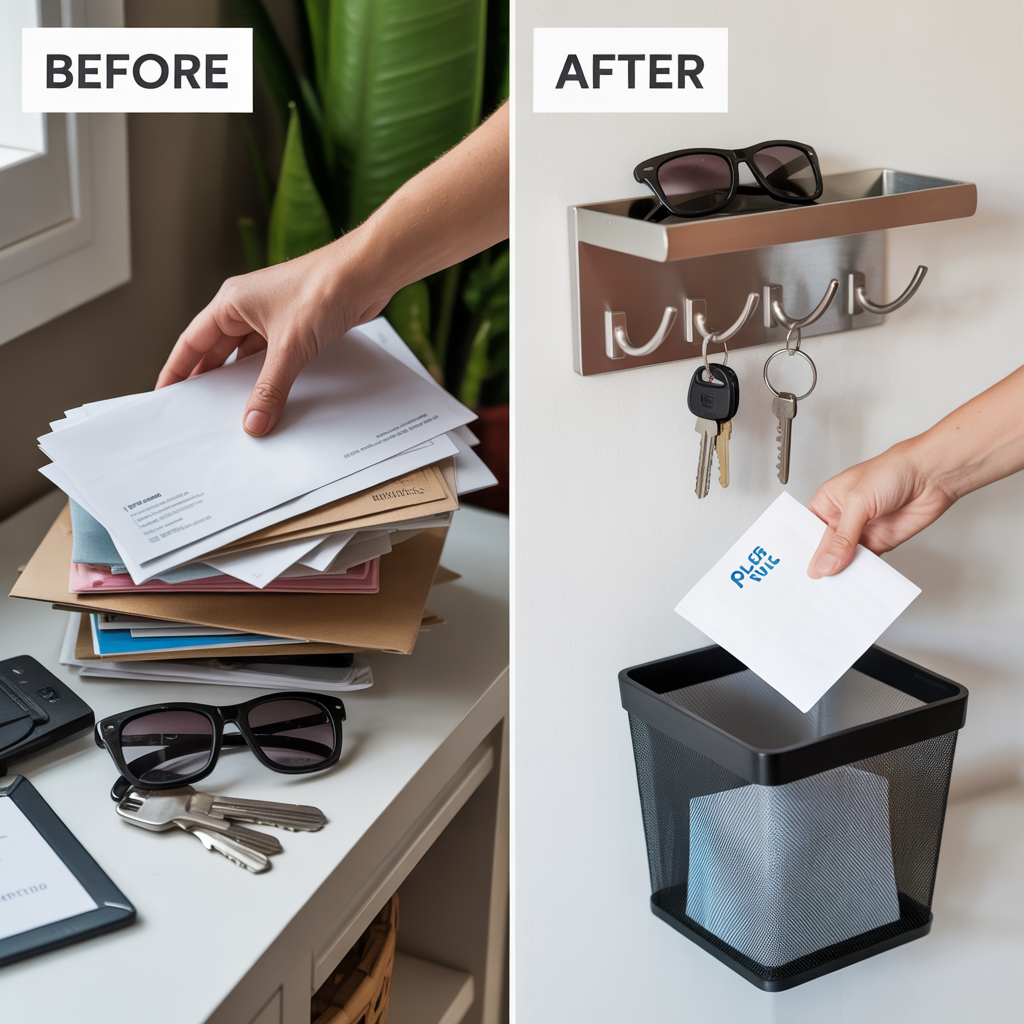
We all have them. Those mysterious, seemingly self-replicating piles of stuff that haunt our homes. It’s the “doom pile” of mail and catalogues on the kitchen counter. It’s the “chair-drobe” in the bedroom, draped with clothes that are not quite dirty but not quite clean. It’s the entryway table that acts as a magnet for keys, sunglasses, loose change, and forgotten items.
This creeping, daily clutter is one of the most persistent sources of stress in a modern home. And it doesn’t happen because of one big messy event; it’s the result of a thousand tiny, deferred decisions.
Every time you set something down “just for now,” you are not saving time. You are making a subconscious contract with your future self to deal with it later. You are creating a future problem. But what if you could intercept that habit at its source?
What if there was a single, powerful, and almost ridiculously simple system that could eliminate the vast majority of this daily clutter before it ever has a chance to form?
There is. It’s called the One-Touch Rule, and it’s less of a cleaning hack and more of a life-altering habit. In this guide, we will explore the deep-seated psychology of why we create these piles and provide a step-by-step manual for implementing this rule. This is your definitive guide on how to deal with daily clutter and create a home that stays tidy with astonishingly little effort.
The Psychology of Clutter: Why We Don’t Put Things Away
To master the rule, you must first understand the behavior it’s designed to correct. We don’t create piles because we are lazy; we create them because our brains are wired for efficiency, and sometimes, that wiring short-circuits.
The “Decision Fatigue” Factor
As we explored in my guide to Decision Fatigue, our willpower is a finite resource. After a long day, the simple act of deciding where an item should go is still a micro-decision. Confronted with a piece of junk mail, your brain has to decide: Is it trash? Recycling? Does it need to be shredded? Does it contain a bill I need to file? When your “decision muscle” is tired, the easiest path is to defer the decision entirely by putting the mail down on the counter. Problem postponed. Clutter created.
The Lack of a “Home”: The Problem of Item Homelessness
This is the single biggest cause of clutter. An item cannot be put away if it does not have a designated, easy-to-access “home.” If you don’t have a specific hook for your keys, they will live on the entryway table. If you don’t have a designated spot for batteries, they will live in the junk drawer. Clutter is simply the physical manifestation of items that lack a home.
The “I’ll Do It Later” Fallacy
Our brains are terrible at accurately predicting future effort. We look at a coat and think, “It will take 15 seconds to hang that in the closet. I’ll do it later.” What we fail to calculate is the cumulative mental and physical effort required to deal with a chair that has 10 items draped over it. We trade a 15-second task now for a 5-minute task later, and we do it dozens of times a day.
The One-Touch Method Explained: A System for Immediate Action
The One-Touch Rule is the direct antidote to all three of these psychological traps. It is a simple, non-negotiable system for handling objects.
The Core Rule Defined
From the moment an object enters your hand, your goal is to take it to its final destination in one continuous motion. It should never be put down on an intermediate surface.
That’s it. You touch it once.
- The mail comes through the door. You touch it once on its journey to the recycling bin (for junk) or the “bills to pay” folder (for important items). It never touches the kitchen counter.
- You take off your coat. You touch it once as you walk to the closet and hang it up. It never touches the back of a chair.
- You take off your shoes. You touch them once as you place them in the shoe rack or closet. They never form a pile by the door.
A System, Not a Suggestion
For this to work, you must treat it as a hard-and-fast rule, almost like a game you play with yourself. The goal is to consciously interrupt the old, ingrained habit of “set it down” and forge a new neural pathway for “put it away.” At first, it will feel deliberate and maybe even a little tiring. But after a few weeks of conscious application, it becomes automatic. It becomes the new default.
Setting Yourself Up for Success: Creating “Homes” for Everything
The One-Touch Rule is impossible to implement if your items are “homeless.” This preparatory step is what makes the system work. You must give every object a logical, convenient place to live.
Designate an Entryway “Landing Strip”
The front door is the primary entry point for clutter. You must fortify it.
- Keys: Install simple hooks right by the door. This is the designated home for keys. No exceptions.
- Wallets, Sunglasses, etc.: Place a small, attractive tray or bowl on your entryway table. This is the designated home for pocket contents.
- Bags & Purses: Install a sturdy hook or designate a specific spot on a bench or in a closet.
Create a Mail Processing Station
This is a game-changer for mail clutter. Place a recycling bin or paper shredder near the door where you bring in the mail.
- The rule is simple: you process your mail as you walk in.
- Junk mail, flyers, and envelopes go directly into the recycling. Touched once.
- Bills go directly into a “To Be Paid” folder. Touched once.
- Magazines go directly to the coffee table or magazine rack. Touched once.
The “Does This Live Here?” Audit
Walk over to your biggest clutter hotspot. Pick up one item. Let’s say it’s a pair of scissors. Ask yourself, “What is the designated, permanent home for these scissors?” If the answer is “uh, that drawer with all the random stuff,” you haven’t given it a real home. The answer should be specific: “The top-left desk drawer, in the pen holder.” If an item doesn’t have a home, the task is to create one for it right now.
A Day in the Life with the One-Touch Method
Let’s see how this system transforms a typical day.
- Morning Routine: You finish your coffee. You touch the mug once on its way to the dishwasher. You finish with your towel after a shower. You touch it once as you hang it on the hook to dry. You take off your pajamas. You touch them once on their way into the hamper. There is no pile of used towels or clothes on the floor.
- Arriving Home: You walk in the door. The keys are touched once and placed on their hook. The mail is touched once and immediately sorted into the trash or the “action” folder. Your coat is touched once and hung in the closet. Your shoes are touched once and placed on the shoe rack. You have been home for 60 seconds, and you have generated zero clutter.
- Evening Routine: You finish reading a book on the couch. You touch it once as you place it back on the bookshelf. The TV remote is touched once as it goes back into its designated tray on the coffee table. The empty glass goes to the kitchen sink. The living room remains in a state of “reset” with minimal effort.
Frequently Asked Questions (FAQ)
- This sounds exhausting. Do I really have to do this for every single item?
- Initially, it feels like more effort because you are consciously breaking a lifelong habit of deferring decisions. However, the energy it takes to put one item away is minuscule compared to the physical and mental energy required to deal with a massive pile of 50 items later. After a few weeks, this new habit becomes automatic and requires less energy than the low-grade stress of living with clutter.
- What do I do if an item’s “home” is inconvenient or far away (e.g., upstairs)?
- This is a sign of an inefficient system. If you find yourself consistently leaving things in a pile because their home is inconvenient, you have two choices: 1) Move the item’s home to a more convenient location, or 2) Create a “transit station.” A single, attractive basket at the bottom of the stairs can be the designated home for “things that need to go upstairs.” The rule then becomes: touch the item once to put it in the transit basket. The next time you go upstairs, you touch the basket once to take it with you.
- My kids/partner are the main source of the clutter. How can I get them to adopt this rule?
- Lead by example. First, master the rule for your own belongings. This alone will dramatically reduce the clutter. Second, make it easy for them by ensuring everything has a clear, logical, and easy-to-use home (e.g., low hooks for kids’ jackets, open bins for toys). You can “gamify” it for kids (“Can you one-touch your toys back into the bin?”). For a partner, have a calm conversation about the “piles” and introduce the concept as a stress-reducing experiment you’d like to try together.
- What’s the difference between this and just “being tidy”? It sounds the same.
- “Being tidy” is a description of a person’s character. The One-Touch Rule is a description of a system. Many people want to be tidy but lack the system to achieve it. This rule provides the operational mechanics for tidiness. It turns a vague personality trait into a simple, binary action: either you put the item down, or you put it away.
- I’m a naturally “messy” person. Can a system like this really change my lifelong habits?
- Yes. In fact, it’s designed for you. “Naturally tidy” people often do this instinctively. For those who aren’t, habits aren’t changed by willpower alone; they are changed by implementing better systems. This rule isn’t about changing your personality. It’s about giving your “messy” personality a simple, powerful tool that makes tidiness the path of least resistance.
The Ripple Effect of a Single Habit
The One-Touch Rule, at its heart, is a mindfulness practice disguised as a cleaning trick. It forces you to be present in the small moments of your day. It asks you to be intentional with every object you interact with. It is a commitment to your future self, a promise not to burden them with the deferred decisions of your present self.
The effect is profound and creates a powerful ripple. A clutter-free space reduces your background stress and visual noise. This, in turn, frees up your mental energy and reduces decision fatigue. With more mental energy, you’ll find it easier to tackle bigger goals and projects. It all starts with the simple, powerful act of touching something just once. You are not just conquering clutter; you are designing a life of greater clarity, peace, and intention.

C. Holmes is the keen analytical mind behind Infinitas Minds, a blog dedicated to revolutionizing the way we approach home economics. With a meticulous eye for detail and a passion for logical solutions, C. Holmes tackles everyday challenges to reveal hidden opportunities for efficiency and savings. His mission is to simplify life, spark innovation, and offer practical, insightful approaches for navigating our often-complex world with greater ease and financial clarity.
Driven by a belief that true mastery of home economics lies in understanding the ‘why’ and ‘how’ behind every decision, C. Holmes curates comprehensive guides, actionable experiments, and groundbreaking perspectives. Expect a blend of sharp analysis, creative problem-solving, and a touch of ingenuity in every piece, empowering readers to transform their homes into havens of efficiency and peace.