
In every household, there exists an invisible, high-stress job often performed by one person: the role of the Central Processing Unit (CPU). This person tracks the dental appointments, knows when the bills are due, remembers where the spare batteries are, and manages the ever-changing grocery list.
This relentless, invisible work is the very definition of mental load, and it is exhausting. The constant juggling of information creates a state of chronic, low-grade stress. But what if you could fire yourself from this job? What if you could create a physical, visual system that takes on this burden for you?
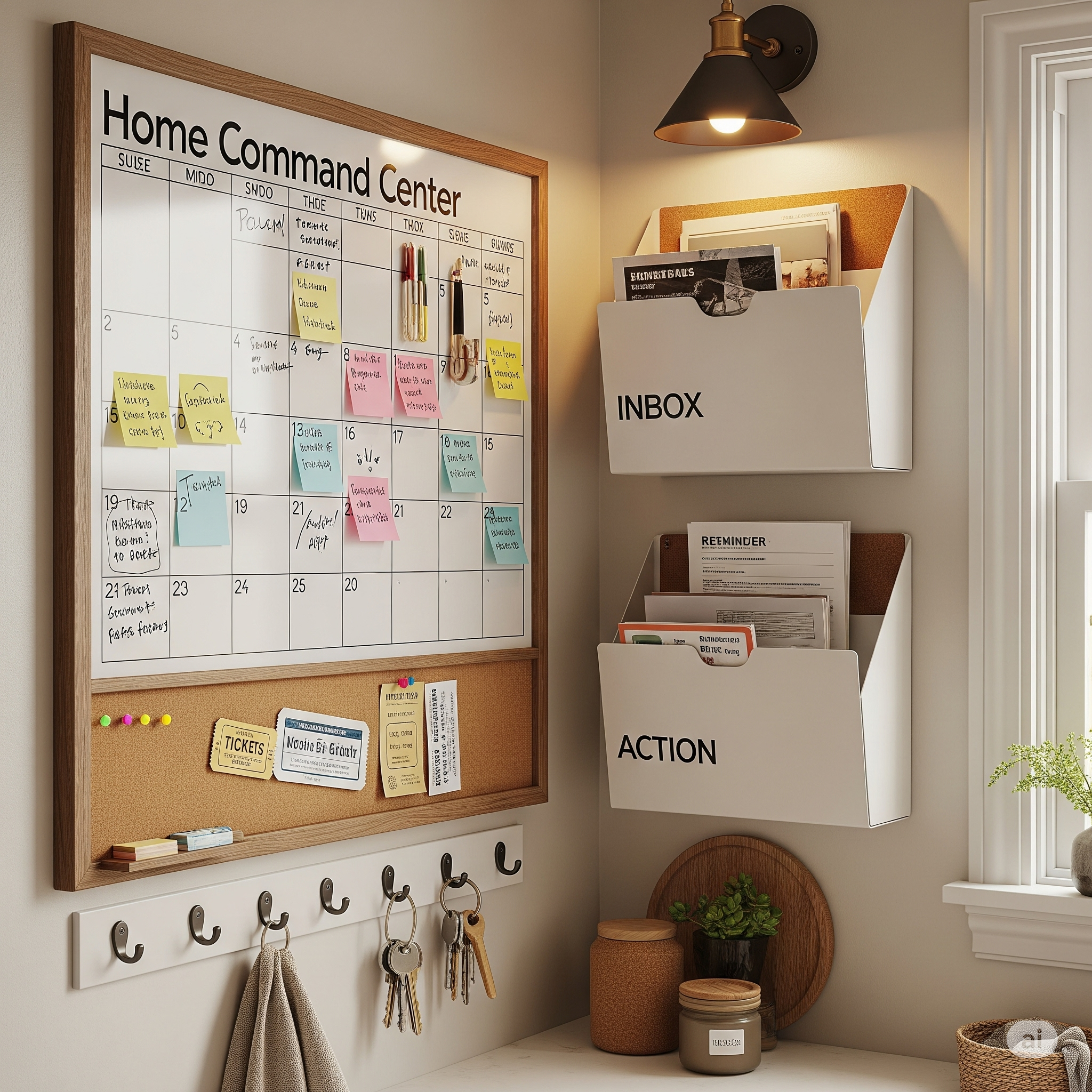
Welcome to the concept of the Home Command Center. This is not just a fancy name for a bulletin board; it is a dedicated, strategically designed space in your home that serves as the central hub for all incoming and outgoing information, tasks, and essential items. It is the physical embodiment of an organized mind.
Creating one is a transformative DIY project that bridges the gap between practical organization and intentional living.
This guide will walk you through the process of designing and implementing a command center tailored to your specific needs.
We will explore the essential components, from calendars to mail systems, and show you how this single project can dramatically reduce your mental load, improve household communication, and bring a profound sense of calm and control to your daily life.
The “Why”: The Science of Externalizing Your Brain
Before you pick up a drill, you must understand the powerful psychology behind why a command center is so effective.
Offloading Your Working Memory
As we’ve discussed in our guide to The Visual Inventory, our working memory is incredibly limited. Trying to remember your to-do list, your kids’ schedules, and your grocery needs all at once is like running too many programs on a computer—everything slows down.
A command center acts as an external hard drive for your brain. By writing information down and placing it in a trusted, visible system, you give your brain permission to let go of it. This frees up immense cognitive resources for more important things, like problem-solving and being present.
Creating a “Single Source of Truth”
How many times has this happened: “Did you remember to…?”, “Where is the permission slip?”, “When is that appointment?”.
This constant back-and-forth communication is a major source of friction in a household. A command center becomes the “single source of truth.”
The family is trained to look at the central calendar or the “action” basket first. This fosters independence and reduces your role as the sole keeper of information.
Making the Invisible Visible
Much of the work of running a home is invisible, which can lead to feelings of being unappreciated or overwhelmed.
A command center makes this labor visible. The calendar shows the complexity of the family schedule; the mail sorter shows the administrative tasks that need handling.
This visual clarity can lead to a more equitable distribution of household responsibilities.
Phase 1: The Design & Planning Stage
A successful command center is designed, not just assembled.
Step 1: Define Your Mission. What Problems Will It Solve?
Before you buy a single hook, take 15 minutes to diagnose your household’s biggest pain points.
Grab a notebook and answer these questions:
What type of clutter constantly accumulates on our kitchen counter? (Mail, keys, school papers?)
What information do I have to repeat most often to my family? (Dinner plans, schedule for the day?)
What are the most common “I can’t find the…” items in our home? (Scissors, tape, stamps?)
What important tasks are falling through the cracks? (Paying bills, RSVPing to events?)Your answers will form the “mission brief” for your command center.
You are not building a generic system; you are building a custom solution to your specific problems.
Step 2: Choose Your Location
The command center must be located in the high-traffic “central artery” of your home. For most families, this is the kitchen or the main entryway/hallway.
It needs to be a place you see and interact with multiple times a day. Look for a sliver of unused wall space—it doesn’t need to be huge.
A small section of wall next to the fridge or near the door is perfect.
Phase 2: Selecting Your Components
Now, based on your mission, you will select the modular components for your command center. Mix and match from the list below.
The “Time” Component: The Master Calendar
This is the non-negotiable heart of the system.
Options: A large whiteboard calendar (for easy erasing), a chalkboard calendar (for a rustic look), a large paper wall calendar, or even a permanently mounted digital tablet synced to a shared family calendar (like Google Calendar).
Best Practice: Assign a different color marker/pen to each family member for at-a-glance clarity.
The “Information In” Component: The Mail & Paper System
This is your defense against the paper pile-up.
Options: Wall-mounted letter sorters or magazine files are excellent. * The System: Create a simple, three-tiered system based on the One-Touch Rule:
INBOX: All new mail and school papers go here immediately.
ACTION REQUIRED: Items that need to be paid, signed, or RSVP’d to.
TO FILE: Important documents that need to be kept long-term.
Crucially, place a recycling bin or shredder directly underneath this system. The goal is to process the junk mail immediately.
The “Information Out” Component: The Message Board
This is for dynamic, short-term communication.
Options: A corkboard for pinning tickets, invitations, and reminders. A small whiteboard or chalkboard for jotting down quick notes (“Don’t forget soccer practice is at 6 PM today!”).
The “Essential Tools” Component: The Utility Hub
This answers the “I can’t find the…” problem.
Options: A small pegboard is incredibly versatile. You can use it to hang:
A key rack with designated hooks for each set of keys.
A small basket for pens, markers, and a pair of scissors.
A roll of tape.
A small charging station for phones.
The “Planning” Component: The Lists
This is for tracking ongoing needs.
Options: A dedicated section on your whiteboard for a running “Grocery List” and a “To-Do List.” A tear-off paper list pad also works well.
The Rule: Anyone in the house who uses the last of the milk is responsible for writing “milk” on the grocery list. This automates the process and distributes the responsibility.
Phase 3: Assembly & Implementation
Now it’s time to build.
Measure and Map: Before drilling any holes, lay out all your components on the floor to get the spacing right. Use painter’s tape on the wall to mark out where each piece will go. Use a level to ensure everything is straight.
Install Securely: Use the appropriate wall anchors and screws for your wall type (drywall, brick, etc.). A command center that falls off the wall is not a stress-reducer. This is a great time to use your Basic Home Repair Skills.
Launch and Train: Once it’s built, hold a 10-minute “family meeting.” Explain how the system works in simple terms. Show everyone where the calendar is, how the mail system works, and where the keys now “live.” The first week will require gentle, consistent reminders to use the new system.
Frequently Asked Questions (FAQ)
My apartment is tiny and I have no free wall space. Can I still create a command center?
Yes! Think vertically and unconventionally. The side of your refrigerator is a magnetic goldmine—use magnetic calendar boards, file holders, and small baskets. The inside of a kitchen cabinet door is another fantastic, hidden spot. You can mount a corkboard, a small whiteboard, and a calendar on the inside of the door, keeping it completely out of sight but still highly functional.
This seems like it could get very expensive. How can I do this on a budget?
You can create a highly effective command center for very little money. Calendar: Print out free monthly calendar templates and clip them to a clipboard. Message Board: Frame a piece of decorative paper or fabric and use the glass as a dry-erase board. Mail Sorter: Repurpose old magazine files or even sturdy cereal boxes cut on an angle. Utility Hub: Upcycle old jars to hold pens and scissors.
I love the idea of a digital calendar, but how do I make it a central part of a physical command center?
An old tablet that is no longer your primary device can be perfect for this. Mount it on the wall using a secure tablet holder and keep it permanently plugged in and open to your shared family calendar app. It becomes a dynamic, always-updated part of your physical display.
How do I stop the command center itself from becoming a cluttered mess?
This is a crucial point. The command center needs its own “Closing Shift” Routine. Schedule 10 minutes every Sunday as part of your Sunday Reset to “reset the reset.” This means wiping the calendar clean for the new week, clearing out the “Action” folder, and tidying up the message board. This regular maintenance is what keeps the system functional.
My family is resistant to new systems. How can I get them to actually use it?
The key is to demonstrate its value by making their lives easier. When your partner asks, “What’s the plan for Saturday?”, you can cheerfully say, “I’m not sure, check the command center!” When your child can’t find the tape, you can direct them to the utility hub. The more you use it as the “single source of truth,” the more they will learn to rely on it. Make it collaborative by letting them choose their own color marker for the calendar. The goal is to show that it’s a tool that helps everyone, not just a set of rules you are imposing.
The Calm of Centralized Control
A Home Command Center is far more than a collection of organizational tools; it is a physical manifestation of an intentional life. It is the act of taking the chaotic, invisible data of household management and giving it a clear, calm, and centralized home.
By building this system, you are not just organizing your mail and your schedules; you are offloading your mental load, reducing household friction, and creating a shared language of organization for your entire family.
You are moving from a state of reactive chaos to one of proactive control. And that feeling of calm, centralized control is one of the greatest gifts you can give yourself and your home.

C. Holmes is the keen analytical mind behind Infinitas Minds, a blog dedicated to revolutionizing the way we approach home economics. With a meticulous eye for detail and a passion for logical solutions, C. Holmes tackles everyday challenges to reveal hidden opportunities for efficiency and savings. His mission is to simplify life, spark innovation, and offer practical, insightful approaches for navigating our often-complex world with greater ease and financial clarity.
Driven by a belief that true mastery of home economics lies in understanding the ‘why’ and ‘how’ behind every decision, C. Holmes curates comprehensive guides, actionable experiments, and groundbreaking perspectives. Expect a blend of sharp analysis, creative problem-solving, and a touch of ingenuity in every piece, empowering readers to transform their homes into havens of efficiency and peace.