
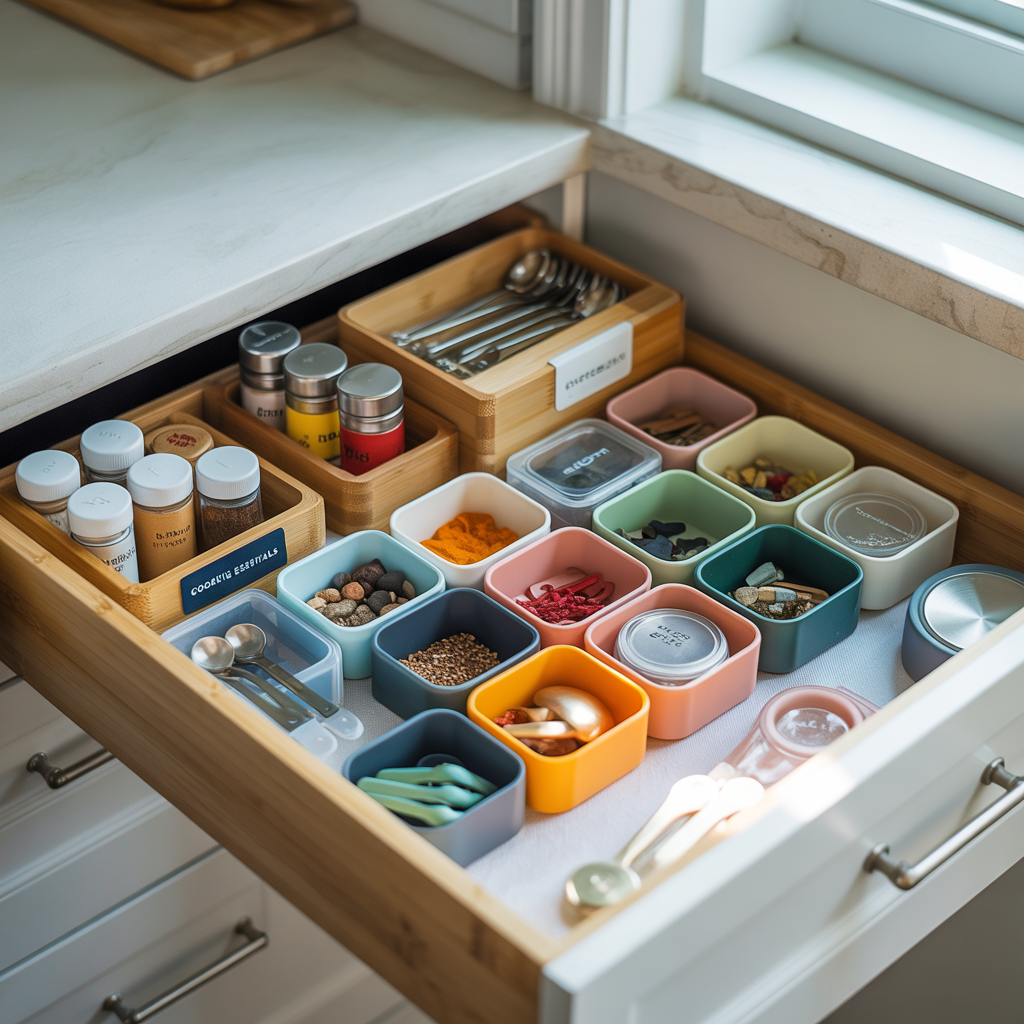
Can’t find anything in your small kitchen drawers, constantly battling utensil chaos or that ever-growing “junk drawer”? My upbeat guide to brilliant small kitchen drawer organization ideas is here to tell you that yes, you can conquer that clutter today!
If you’re frustrated with digging for the right spatula or facing an avalanche of miscellaneous items every time you open a drawer, you’re not alone.
As a no-nonsense efficiency expert, I’m excited to share my favorite “MacGyver” tricks and highly practical solutions to transform your drawer chaos into calm, functional efficiency, maximizing every precious inch.
This isn’t about buying a slew of expensive, one-size-fits-all organizers. It’s about smart decluttering first, followed by resourceful strategies – many of them DIY or incredibly low-cost – to create customized systems that work for your items and your small drawers.
I’ll show you how to tame the utensil jungle, conquer the gadget graveyard, and even bring order to that dreaded junk drawer. We’re going to look at clever ways to use dividers, containers, and even think vertically and diagonally to make the most of limited space.
By the end of this guide, you’ll have a toolkit of ingenious ideas to not only organize your current drawers but also to maintain that hard-won order with simple habits. Let’s roll up our sleeves and turn those messy drawers into masterpieces of efficiency!
2. The “Before You Buy Anything” Drawer Detox: Your First Step to Sanity
Alright, let’s get straight to it – if you’re serious about achieving drawer sanity and implementing effective small kitchen drawer organization ideas, then the “before you buy anything” drawer detox is your absolute, non-negotiable first step. As a no-nonsense efficiency expert, I can tell you that trying to organize clutter is like trying to neatly arrange trash – it just doesn’t work in the long run! You can buy all the fancy drawer dividers in the world, but if you haven’t purged what you don’t need, use, or love, you’ll just end up with neatly organized clutter. This initial detox is where the real magic begins, freeing up space you didn’t even know you had.
This isn’t about a massive, overwhelming overhaul. We’re tackling this one drawer at a time. Pick your most frustrating drawer to start with – maybe it’s the utensil drawer, the gadget drawer, or that infamous “junk drawer.”
- Step 1: Empty Completely (The “Blank Slate” Approach)
- Your Action: Take everything out of the chosen drawer. Yes, every single item. Place it all on a clear counter or your kitchen table. This might look a bit scary at first, but it’s essential to see the full scope of what you’re dealing with and to give the drawer itself a good clean.
- Upbeat Tip: Put on some music! Make it a quick, energetic task.
- Step 2: The Ruthless (But Necessary) Purge & Clean
- Your Action: Now, with the drawer empty, give it a thorough wipe-down. Get rid of any crumbs, dust, or sticky spots. A clean drawer feels like a fresh start.
- Next, go through every item you pulled out. Ask yourself these pragmatic questions:
- “Do I actually use this regularly?” (If not in the last 6-12 months, probably not).
- “Is it broken, damaged, or missing parts?”
- “Do I have duplicates (or triplicates!) of this item?” (How many potato peelers does one person really need?)
- “Does this item even belong in the kitchen, or in this drawer?”
- Be Decisive: Have your “Donate,” “Discard/Recycle,” and “Relocate” boxes ready.
- Discard/Recycle: Broken items, things beyond repair, truly useless gadgets.
- Donate: Duplicates in good condition, items you never use but someone else might.
- Relocate: Items that belong in a different room or a more appropriate spot.
- Step 3: Group Like with Like (The “Aha!” Moment of Sorting)
- Your Action: As you decide to keep items, start grouping similar things together on your counter. All your measuring spoons in one pile, all your spatulas in another, all your can openers together, etc.
- Why This is Key: This visual grouping is often an “aha!” moment. You’ll clearly see if you have an excessive amount of one particular item. It also helps you understand the types and sizes of items you need to find a home for back in the drawer, which is crucial before you even think about organizers.
This detox process is the foundation for all successful small kitchen drawer organization ideas. It’s not always the most glamorous part, but I promise you, clearing out the unnecessary clutter first will make the actual organizing part much easier, more effective, and infinitely more satisfying. You’re creating space not just in your drawers, but in your mind too!
3. Taming the Utensil Jungle: Smart Hacks for Silverware and Cooking Tools
Ah, the utensil jungle – that chaotic drawer where forks wage war with spoons, and finding the right spatula feels like an archaeological dig! If this sounds familiar, you’re ready for some smart hacks for your silverware and cooking tools, a key battleground in our quest for small kitchen drawer organization ideas. As an upbeat problem-solver, I’m excited to share some “MacGyver-esque” tricks that go beyond those standard, often ill-fitting, plastic trays to truly maximize your space and restore order.
Forget just dumping everything in. Let’s get clever and efficient:
- Rethink the Basic Tray (Or Ditch It!):
- Standard silverware trays are often a poor fit for small or oddly shaped drawers, leaving wasted space around the edges or not accommodating all your utensil types.
- The “MacGyver” Upgrade – DIY Dividers: This is where your resourcefulness shines!
- Sturdy Cardboard: Cut strips of thick cardboard (from an old shipping box) to the height of your drawer. You can make them look surprisingly chic by covering them with attractive contact paper, oilcloth, or even washi tape. Create custom-sized compartments by notching and interlocking the strips, or by gluing them into a configuration that perfectly fits your utensils.
- Thin Wood Scraps/Balsa Wood: If you’re a bit handy, thin strips of balsa wood (from a craft store) or leftover wood scraps can be cut and glued to create durable, custom dividers.
- Small Tension Rods (Spring-Loaded): These are fantastic for instant, adjustable compartments! Use small, inexpensive spring-loaded tension rods (often sold as curtain rods for small windows or as drawer dividers themselves) either vertically or horizontally within the drawer to create defined lanes for different utensil types. No cutting or gluing needed!
- Vertical Victory – When Drawer Height Allows:
- If you have a deeper drawer that’s currently a jumble of cooking tools (whisks, ladles, spatulas), consider going vertical.
- The Hack: Repurpose narrow containers, sturdy glass jars (ensure they won’t tip easily), or even clean tin cans (with smooth edges!) to stand utensils upright within the drawer. This often uses space much more efficiently than laying everything flat and makes items easier to see and grab.
- Countertop Option (to free up drawer space): If drawer space is at an absolute premium, a stylish crock or container on your countertop can hold frequently used cooking tools, freeing up an entire drawer.
- The “File, Don’t Pile” Method for Flatter Tools:
- For flatter items like peelers, can openers, pizza cutters, or small graters, piling them on top of each other is a recipe for frustration.
- The Solution:
- Shallow, Stackable Organizers: Look for inexpensive, shallow, interlocking drawer organizers that allow you to “file” these items on their sides or in individual shallow compartments.
- DIY Again! Small, repurposed boxes (like checkbook boxes or small gift boxes) can often fit within a drawer to create individual slots for these items.
- Group by Function and Frequency of Use:
- Within your newly divided or containerized system, group items by how you use them. All your everyday eating silverware together. Baking utensils in one section, grilling tools in another (if they live in a kitchen drawer).
- Keep the most frequently used items in the most accessible part of the drawer.
By applying these small kitchen drawer organization ideas with a dash of “MacGyver” ingenuity, you’ll transform that utensil jungle into a streamlined, efficient space where everything has its place and is easy to find. No more rummaging – just grab and go!
4. Conquering the Gadget Graveyard & The Dreaded “Junk Drawer”
Ah, the infamous duo: the “gadget graveyard” overflowing with once-loved (or rarely used) kitchen tools, and its notorious sibling, the “junk drawer,” a black hole of miscellaneous oddities. If you’re aiming for true small kitchen drawer organization ideas that bring lasting calm, conquering these two challenging spaces is a must. As your upbeat problem-solver, I’m here to tell you that even these seemingly hopeless drawers can be tamed with a bit of ruthless decluttering and some clever organizational tricks! Let’s transform them from sources of frustration into zones of (organized!) utility.
Tackling the Gadget Graveyard:
This drawer often houses everything from that apple corer you used once to the melon baller gathering dust. It’s prime real estate in a small kitchen!
- The Brutally Honest Assessment (The “One Year” Rule & Beyond):
- Pull everything out. Now, be brutally honest with yourself for each gadget:
- “Have I used this in the last year?” If not, the chances are high you don’t truly need it taking up precious drawer space.
- “Does it perform a unique function that another, more versatile tool I own can’t do?” (e.g., Do you need a specific strawberry huller if a small paring knife works fine?)
- “Is it broken or a pain to use/clean?”
- The “One In, One Out (Or Two Out!)” Philosophy for Gadgets: For every new kitchen gadget that comes in (if you absolutely must have it), make a rule that at least one (or even two!) old, underused ones must go out. This is a great habit for preventing future graveyard scenarios.
- Pull everything out. Now, be brutally honest with yourself for each gadget:
- Relocate, Donate, or Discard:
- Relocate: Some gadgets might be useful but are only used seasonally or very rarely (e.g., turkey baster, cookie press). Can these be stored elsewhere, like a higher cabinet or a storage box, to free up prime drawer real estate?
- Donate: Gadgets in good working order that you simply don’t use can find a new life with someone else.
- Discard/Recycle: Broken or truly useless items.
Transforming the Dreaded “Junk Drawer” into a “Useful Things” Drawer:
Let’s reframe it: a “junk drawer” doesn’t have to be junk. It can be an organized collection of small, useful, miscellaneous household items. The key is containment and categorization, even for the random bits and bobs.
- Small Containers are Your Superheroes (The “MacGyver” Approach):
- This is where your inner resourcefulness really shines! Don’t rush out to buy expensive organizers. Look around your home for small containers you can repurpose:
- Empty mint tins or small candy tins
- Jewelry boxes or small gift boxes
- Cleaned baby food jars (for very small items like tacks or screws, if it’s a utility-focused drawer)
- Ice cube trays (surprisingly brilliant for tiny office supplies like paperclips, rubber bands, small binder clips, or even craft beads if it’s a multi-purpose drawer!)
- Small Tupperware-style containers without lids, or the lids themselves used as shallow trays.
- This is where your inner resourcefulness really shines! Don’t rush out to buy expensive organizers. Look around your home for small containers you can repurpose:
- The “Zone Defense” – Assigning Mini-Zones:
- Once you’ve decluttered the junk drawer (yes, it needs a ruthless purge too!), use your collection of small containers to create defined “zones” within the drawer.
- Example Zones:
- A small tin for pens and a small notepad.
- A section for basic repair tools (small screwdriver, measuring tape).
- A container for charging cords and small electronics accessories.
- A spot for rubber bands, paper clips, and binder clips.
- A designated area for keys, loose change, or loyalty cards (if this is where they land).
- The idea is that everything has a “micro-home,” preventing it from becoming a jumbled mess.
- Vertical Thinking (If Drawer Height Allows):
- Sometimes, small items like pens or scissors can be stored upright in a very small cup or container within the junk drawer to save flat space.
By applying these focused strategies, you’re not just implementing small kitchen drawer organization ideas; you’re reclaiming valuable space and banishing some of the biggest sources of kitchen frustration. An organized gadget drawer and a truly useful “useful things” drawer are well within your reach!
5. Maximizing Every Inch: Genius Vertical & Unconventional Storage Tricks
You’ve detoxed, you’ve tamed the utensil jungle, and you’ve even brought order to the gadget graveyard and junk drawer – bravo! Now, for those of us truly obsessed with small kitchen drawer organization ideas and squeezing every last bit of utility from our limited spaces, it’s time for some genius vertical and unconventional storage tricks. This is where your inner “MacGyver” can really shine, finding clever ways to use often-overlooked dimensions and surfaces within your drawers. As an upbeat problem-solver, I love these little hacks that make a big difference!
Get ready to think outside the (drawer) box:
- Drawer Liners That Do Double Duty (More Than Just Pretty!):
- The Basics: A good non-slip drawer liner is always a smart start. It stops things from sliding around, which in itself is a form of organization.
- The “MacGyver” Twist – DIY Compartmentalized Liners:
- Instead of just a flat liner, create your own shallow “walls” or compartments directly on the liner or drawer bottom.
- How? Use strips of sturdy craft foam, thin balsa wood (from a craft store), or even cut-up pieces of (clean!) plastic food containers. Glue these strips in a grid or custom pattern to create perfect little corrals for small items like spice jars (if in a shallow drawer), tea bags, or small condiment packets.
- This uses the base of the drawer more effectively than just letting small items roll around.
- Stacking Smartly & Safely (Going Vertical Inside the Drawer):
- If you have drawers with a bit of height, don’t just let that vertical space go to waste.
- Purpose-Made Stacking Organizers: There are many inexpensive stacking drawer organizers designed for cutlery, utensils, or small office supplies that can be adapted for kitchen items. Look for ones with a small footprint.
- Repurpose and Stack: Can small, sturdy, lidded containers (that you’ve decluttered from your pantry!) be stacked neatly in a deeper drawer to hold things like cookie cutters, small baking supplies, or bulk spices (if transferred from bags)?
- The “Nesting” Principle: Store items that nest (like measuring cups and spoons) together, with the largest on the bottom.
- Safety Note: Ensure any stacked items are stable and won’t topple or make the drawer hard to open/close.
- Thinking Diagonally – The Long Utensil Solution:
- This is a classic “aha!” moment for many. If you have long utensils (like serving spoons, whisks, or BBQ tools) that don’t quite fit horizontally or vertically in a shallow drawer:
- The Trick: Try placing them diagonally from one corner to the opposite. You’d be surprised how often this simple shift allows them to fit perfectly, utilizing the longest dimension of the drawer.
- Using the Inside Walls of Deeper Drawers (With Care!):
- This is for the truly adventurous “MacGyver” organizer, and works best in deeper utility drawers.
- The Idea: Can you attach very lightweight storage to the inside vertical sides of the drawer?
- Small Magnetic Containers: If your drawer sides are metal (or you can affix a small magnetic strip), tiny magnetic spice tins or office supply containers could hold very small, light items.
- Adhesive Hooks (Command™ style, for example): Could small, flat items with a loop (like some measuring spoon sets or small graters) be hung on an adhesive hook stuck to the drawer side?
- Crucial Caveats:
- Ensure anything attached to the sides doesn’t obstruct the drawer’s movement or catch on anything.
- Only for very lightweight items.
- Test adhesives thoroughly, as some might not hold well with the constant motion of a drawer. This is definitely an “experiment with caution” tip!
- The “Drawer within a Drawer” Concept (Shallow Trays on Top):
- If you have a deep drawer, consider placing a shallow, removable tray or organizer on top of the main contents. This creates a second “level” of organization for smaller, frequently used items, while larger items can be stored underneath. You can often find these trays inexpensively, or even repurpose a shallow box lid.
These unconventional tricks are all about challenging your assumptions about how drawer space “should” be used. By thinking vertically, diagonally, and even utilizing the sides, you can unlock hidden storage potential and truly master your small kitchen drawer organization ideas, making every inch count!
6. Maintaining Your Masterpiece: Quick Habits to Keep Drawer Chaos at Bay
You’ve decluttered, you’ve implemented some brilliant small kitchen drawer organization ideas, and your drawers are looking like masterpieces of efficiency – pat yourself on the back! But as any no-nonsense efficiency expert (or upbeat problem-solver!) will tell you, the job isn’t quite done. Maintaining your masterpiece with a few quick, simple habits is key to keeping that frustrating drawer chaos permanently at bay. The good news is, now that you have systems in place, upkeep is infinitely easier than the initial overhaul!
Think of these as your effortless daily and weekly routines to preserve your hard-won drawer serenity:
- The “Put it Back Properly” Promise – Your Golden Rule:
- The Habit: This is the absolute cornerstone of maintaining any organized space. Every single item you take out of a drawer has a designated “home” now. Make a conscious effort, and encourage everyone in your household, to return items to their exact spot immediately after use.
- Why it Works: It sounds ridiculously simple, but this one habit prevents the slow creep of clutter that eventually leads back to chaos. No more “I’ll put it away later” that turns into “Where did this even come from?”
- Embrace the “One In, One Out” Rule (Especially for Gadgets & Duplicates):
- The Habit: We touched on this for gadgets, but it applies broadly. Before you bring a new utensil, gadget, or even a type of tea into your kitchen that needs drawer space, ask yourself if you can let go of an older, less-used, or duplicate item to make room.
- Why it Works: This prevents your newly organized drawers from becoming overstuffed again. It forces mindful purchasing and helps you maintain that initial decluttered state. It’s a proactive way to manage your small kitchen drawer organization ideas long-term.
- Scheduled Mini-Resets (5 Minutes Can Save Hours!):
- The Habit: Dedicate just 5-10 minutes once a week (or even bi-weekly, depending on your drawer usage) for a super-quick “drawer reset.”
- What to Do: Quickly open your most-used drawers. Anything out of place? Put it back. Any new rogue items landed there? Relocate them. Any tiny bits of debris? Quick wipe.
- Why it Works: These mini-resets catch small bits of disorganization before they snowball into a major re-cluttering project. It’s preventative maintenance that feels effortless compared to a big clean-out.
- The “Don’t Stuff, Reassess” Check-In:
- The Habit: If you find yourself starting to force an item into an already full compartment, or if a drawer is becoming difficult to close, take that as a signal. Don’t just stuff it in!
- What to Do: Take a moment to reassess that specific section. Do you need to declutter a few items again? Could things be arranged more efficiently? Is it time to relocate something that’s not being used frequently?
- Why it Works: This prevents your organized systems from breaking down under pressure. It encourages you to maintain the boundaries you set during your initial organization.
- Wipe Down Regularly (A Clean Drawer is an Inviting Drawer):
- The Habit: When you’re wiping down your kitchen counters, take an extra 30 seconds to quickly wipe out the inside of your most frequently used utensil or silverware drawer with a damp cloth.
- Why it Works: It prevents crumb buildup and keeps the space feeling fresh, making you more inclined to keep it tidy.
These aren’t time-consuming chores; they are small, almost effortless habits that, when practiced consistently, will ensure your small kitchen drawer organization ideas stick around for the long haul. You’ve put in the effort to create efficient, calm drawers – now enjoy the lasting benefits with these simple upkeep strategies!
7. Your Small Drawers, Big Wins: Enjoying the Efficiency and Calm!
And there you have it – a collection of my favorite “MacGyver” tricks and no-nonsense strategies for conquering even the most chaotic small kitchen drawers! From the essential “before you buy anything” detox to taming the utensil jungle, vanquishing the gadget graveyard, and implementing those genius space-maximizing hacks, you’re now armed with a wealth of small kitchen drawer organization ideas. My hope is that you’re feeling inspired, empowered, and ready to transform those frustrating spaces into pockets of pure efficiency and calm.
Remember, the journey to perfectly organized drawers isn’t about achieving some unattainable magazine-cover ideal. It’s about creating systems that work for you, your kitchen, and your life. It’s about applying a bit of that upbeat, problem-solving spirit to find clever, resourceful solutions that make your daily routines smoother and less stressful. Those small drawers might be limited in size, but the impact of organizing them well can be a big win for your overall sense of order and peace in the kitchen.
So, embrace the challenge, get creative with your dividers and containers (DIY or otherwise!), and don’t be afraid to tweak your systems as your needs evolve. The real reward is the daily satisfaction of opening a drawer and finding exactly what you need, when you need it, without any rummaging or frustration. Enjoy that newfound efficiency, that extra bit of calm, and the knowledge that you’ve skillfully maximized every precious inch. You’ve got this!
8. FAQ: Your Small Kitchen Drawer Organization Questions Answered
Here are some common questions that pop up when you’re ready to tackle that drawer chaos:
1. I’ve tried organizing my small drawers before, and it never lasts. What makes these ideas different?
The biggest difference often lies in the crucial first step: a thorough declutter or “detox.” Many organizing attempts fail because people try to organize too much stuff. My approach emphasizes purging what you don’t truly need or use before implementing any small kitchen drawer organization ideas. Additionally, focusing on custom or “MacGyver-esque” solutions like DIY dividers often works better in small, awkward drawers than generic organizers that don’t maximize your specific space.
2. What’s the most budget-friendly way to get started with drawer dividers if I can’t DIY them?
If DIY isn’t your thing right now, look for simple, inexpensive solutions. Dollar stores or the clearance sections of home goods stores often have basic plastic trays or small baskets that can work. You can also repurpose small, sturdy cardboard boxes (like those for tea bags, small electronics, or even some food packaging) as instant dividers. The key is to find items that fit your drawer dimensions and create separate compartments without a big spend.
3. My utensil drawer is an odd shape/size, and standard trays don’t fit. Any specific advice?
Oddly shaped drawers are exactly where DIY solutions shine! Consider using:
- Small spring-loaded tension rods: Place them vertically or horizontally to create custom lanes.
- Custom cardboard dividers: Cut sturdy cardboard to fit perfectly, creating sections tailored to your utensils. You can cover them with contact paper for a nicer look and durability.
- Individual small containers/boxes: Instead of one large tray, use several smaller ones that you can arrange to fit the drawer’s unique shape.
4. How do I stop my “junk drawer” from just becoming a mess again a week after organizing it?
The key is to reframe it as a “useful things drawer” and give everything inside a specific home, even if it’s tiny. Use lots of small containers, tins, or even an ice cube tray to categorize items (pens, rubber bands, batteries, etc.). Then, practice the “put it back properly” habit religiously. A quick, 2-minute weekly reset of this drawer can also prevent it from descending back into chaos.
5. I decluttered, but my small drawers still feel too full. What else can I do?
If your drawers still feel packed after a good declutter, consider these:
- A Second, More Ruthless Declutter Pass: Are there items you kept “just in case” that you can now admit you don’t truly need?
- Vertical Storage Outside Drawers: Can any items currently in drawers be moved to wall-mounted storage (e.g., a magnetic knife strip, a utensil rail with hooks, small shelves for spices)? This frees up valuable drawer real estate.
- Assess Quantity vs. Space: Ultimately, you might simply have more items than your small kitchen drawers can comfortably hold. This might mean making tougher choices about what is truly essential for your kitchen.

C. Holmes is the keen analytical mind behind Infinitas Minds, a blog dedicated to revolutionizing the way we approach home economics. With a meticulous eye for detail and a passion for logical solutions, C. Holmes tackles everyday challenges to reveal hidden opportunities for efficiency and savings. His mission is to simplify life, spark innovation, and offer practical, insightful approaches for navigating our often-complex world with greater ease and financial clarity.
Driven by a belief that true mastery of home economics lies in understanding the ‘why’ and ‘how’ behind every decision, C. Holmes curates comprehensive guides, actionable experiments, and groundbreaking perspectives. Expect a blend of sharp analysis, creative problem-solving, and a touch of ingenuity in every piece, empowering readers to transform their homes into havens of efficiency and peace.