
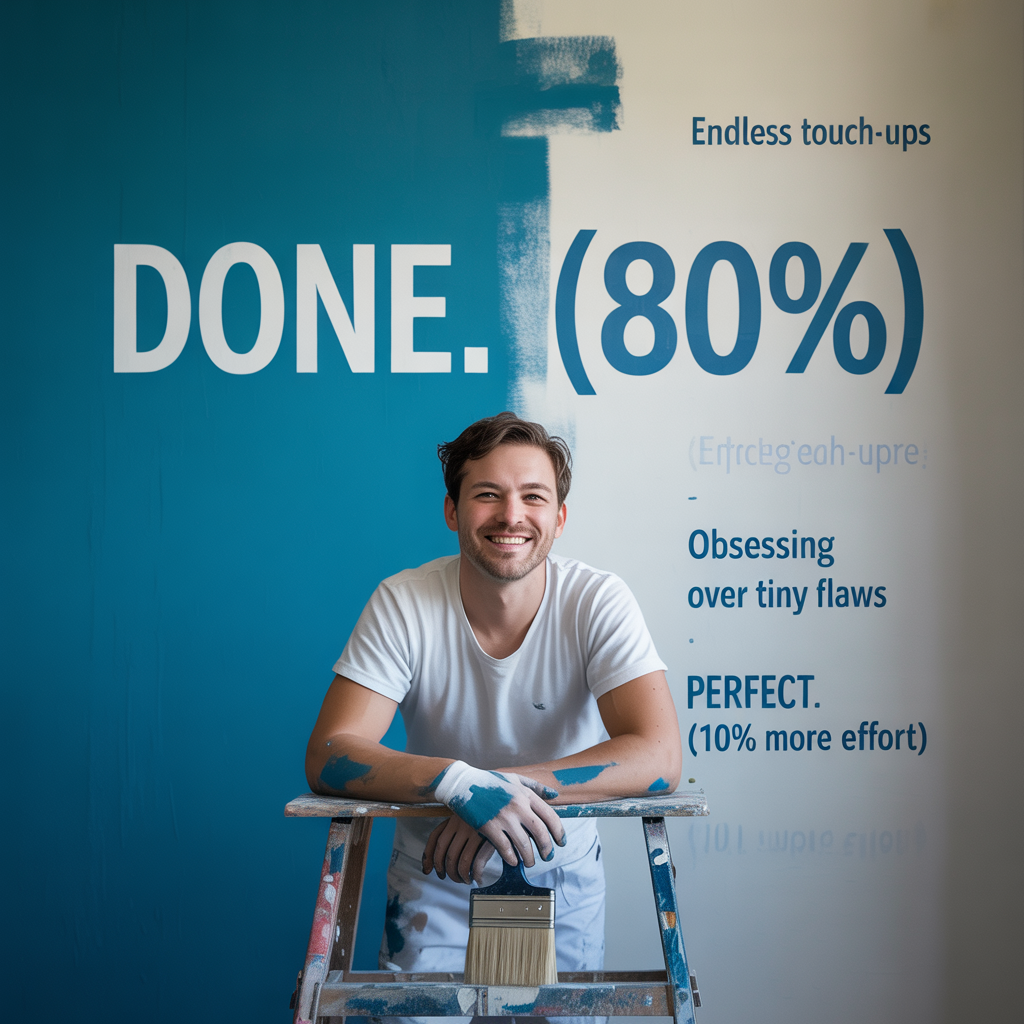
In your mind, the project is stunning. The walls of the guest room are painted a flawless, even shade of sage green. The garage is a sanctuary of perfect organization, with every tool in its place. The thrifted dresser you planned to upcycle is a magnificent, professionally finished centerpiece.
But in reality, the paint cans sit unopened, the garage is still a chaotic mess, and the dresser gathers dust in the corner. You have the tools, you have the time, you have the vision. So why can’t you start?
The invisible barrier holding you back is one of the most powerful and insidious forces in modern life: perfectionism paralysis. It’s the debilitating fear that the real-world result of your efforts will never match the flawless vision in your mind.
So, to protect that perfect vision, you choose not to act at all. You procrastinate, you “do more research,” you wait for the “perfect time.” But the perfect time never comes.
This guide is your permission slip to be imperfect. We will dissect the psychology behind why perfectionism is not about high standards but about a deep-seated fear of failure. Then, I will introduce you to your most liberating new mantra: “Done is better than perfect.”
We will explore how to adopt the “Good Enough Principle” as a strategic tool to break the cycle of inaction and finally experience the profound satisfaction of a finished project.
The Anatomy of Perfectionism: It’s Not About Being Perfect
Understanding this mindset is the first step to dismantling it. Perfectionism is rarely about a genuine love of excellence; it’s almost always about a crippling fear of judgment.
The All-or-Nothing Mindset
Perfectionism operates in a world of black and white. A project is either a “complete success” or a “total failure.” There is no room for a “pretty good” outcome. When the stakes are this high, the pressure to perform becomes immense.
If you believe that anything less than a flawless paint job means you’ve failed, the psychological weight of picking up the brush can feel unbearable. This cognitive distortion is the engine of paralysis.
The Fear of Judgment (From Yourself and Others)
At its core, perfectionism is a defense mechanism. We are afraid of what others will think if they see an imperfection. More often, however, the harshest judge is the one in our own head. We fear the project won’t live up to our own impossibly high standards, and the anticipated self-criticism is so painful that we avoid the activity that might trigger it. The unfinished project, in a strange way, remains perfect in its potential.
How Procrastination Becomes a Shield
For a perfectionist, procrastination is not laziness; it’s a strategic, albeit self-sabotaging, form of self-protection. By delaying the start of a project, you can’t fail at it. If you never start painting the room, you can never create a drip or a crooked line.
As I explored in my guide on how to stop procrastinating cleaning, this choice provides short-term relief from anxiety but guarantees long-term frustration and a home filled with unfinished business.
The “Good Enough” Principle: A Framework for Action and Freedom
The antidote to the poison of perfectionism is the “Good Enough” Principle. This is not an excuse for sloppy work or mediocrity. It is a conscious, strategic decision to value progress over perfection.
Defining “Good Enough”: The 80/20 Rule for Your Home
The Pareto Principle, or the 80/20 rule, states that in many cases, roughly 80% of the results come from 20% of the effort. We can apply this to our home projects. Getting a room 80% organized—where everything is off the floor, categorized, and functional—might take two hours.
Getting it to 100% “perfect”—with every label perfectly aligned and every container matching—could take another eight hours. The “Good Enough” Principle is the wisdom to recognize that the functional, 80% solution that is finished is infinitely more valuable than the 100% perfect solution that never gets completed.
It’s About Progress, Not Apathy
Let’s be clear: “Good Enough” does not mean not caring. It means redefining the goal. Instead of the goal being “a flawless, magazine-worthy room,” the goal becomes “a functional, less stressful room where I can find my things.” It’s about a C. Holmes-like focus on function and systems over purely aesthetic perfection. A well-organized closet where you can see all your clothes is a massive success, even if the hangers don’t all match.
Setting “Good Enough” Goals
The key is to define what “done” looks like before you start. This pre-commitment bypasses the perfectionist’s tendency to continuously move the goalposts.
- Bad Goal (Perfectionist): “I will organize the entire garage perfectly.” (Vague, infinite scope).
- Good Enough Goal (Action-Oriented): “I will clear the floor of the garage, assemble the new shelves, and put all the tools into labeled bins. Done.”
Practical Strategies for Embracing “Good Enough” and Finishing Projects
Knowing the theory is one thing; putting it into practice is another. Here are five actionable strategies.
- Adopt the “Done is Better Than Perfect” Mantra: Write it on a sticky note and put it in your workspace. Repeat it to yourself when you feel the urge to over-analyze or quit. This mantra gives you permission to finish.
- Break It Down into “Imperfect” Steps: A huge project invites perfectionism. Tiny tasks do not. Don’t add “Paint the bedroom” to your to-do list. Add “Step 1: Wipe down the baseboards in the bedroom (15 mins).” Then, “Step 2: Tape the trim around the windows (30 mins).” By breaking the project into small, manageable, and frankly boring steps, you lower the stakes and make it easier to start. This is the 15-Minute Rule applied to projects.
- Set a Public Deadline (The Accountability Hack): This is a powerful tool against the fear of judgment. Tell a trusted friend or family member, “I’m having you over for dinner next Saturday, and I can’t wait for you to see the newly painted bathroom!” This external deadline and social expectation can provide the necessary push to get the project to a “good enough” finished state.
- Celebrate a “Good Enough” Finish: When you reach your pre-defined “good enough” goal, you must celebrate. Do not allow your inner critic to point out the minor flaws. Actively acknowledge your accomplishment. Take a photo. Treat yourself to something nice. This positive reinforcement trains your brain to associate finishing with a reward, which makes it more likely you’ll finish the next project.
- The “Planned Imperfection” Technique: This is a slightly advanced psychological trick, especially for creative projects. Plan to include a small, human, “imperfect” touch. In Japanese pottery, the wabi-sabi aesthetic finds beauty in imperfection. In your project, perhaps you use slightly mismatched knobs on a dresser or allow a brushstroke to be visible. By planning for imperfection, you rob the fear of its power.
Frequently Asked Questions (FAQ)
- How do I know the difference between “good enough” and just being lazy or sloppy?
- The difference is intention. Laziness is avoiding the work. Sloppiness is doing the work carelessly. The “Good Enough” Principle is about doing the work diligently and well up to a pre-defined, functional stopping point. It’s the conscious decision to not spend an extra 8 hours on tiny details that only you will notice and that do not improve the core function of the project.
- I’m a creative person, and my high standards are part of my identity. Doesn’t this mean lowering my standards?
- Not at all. It means redirecting your high standards to what matters. Apply your high standards to the process—the quality of your prep work, the evenness of your first coat of paint. Then, apply your “good enough” standard to the outcome. More importantly, a creative person with ten “good enough” finished projects in their portfolio is far more successful and fulfilled than a creative person with a hundred perfect ideas that never came to fruition.
- This makes sense for chores, but what about a bigger project like an upcycled dresser? I want it to look good.
- Absolutely. The “good enough” goal for a dresser might be very high! It could be: “The finish is smooth to the touch, the color is even, and the hardware is installed securely.” The “perfectionist” goal might be: “There is not a single microscopic dust particle in the finish, the inside of every drawer is also perfectly painted, and the back panel, which no one will ever see, is flawless.” The “Good Enough” Principle allows for high-quality results while protecting you from the obsessive pursuit of the final, invisible 2%.
- My partner is the perfectionist, and it’s stopping us from getting things done as a team. How can I talk to them about this?
- Approach the conversation with empathy, not accusation. Use “I” statements. For example, “I feel overwhelmed when we plan to paint a room because the scope feels so big. Could we try an experiment and define our ‘done’ point before we start? Maybe we can agree that ‘done’ is two even coats on the walls, and we don’t have to worry about the inside of the closet for now.” Focusing on a small, experimental first step is less threatening than trying to change their entire mindset at once.
- What is the first step I can take today to start overcoming my perfectionism paralysis?
- Pick one stalled project. Now, identify the absolute smallest possible physical action you could take to move it forward. Not “sand the table,” but “take the sandpaper out of the package.” Not “organize the closet,” but “take one bag of clothes to the donation bin.” Do that one, tiny, two-minute action. The goal is simply to prove to yourself that you can start, creating a tiny crack in the wall of paralysis.
The Freedom of the Finished Project
Perfectionism promises a world of flawless beauty but often delivers only a locked room of anxiety and unfinished projects. It is a gilded cage, protecting you from criticism but preventing you from growth and accomplishment. The “Good Enough” Principle is not a call for mediocrity; it is the key that unlocks the cage. It is the radical permission to be a human who creates, who tries, and who, most importantly, finishes. The satisfaction you will feel from a home filled with your own “good enough,” completed projects will far outweigh the fleeting, imaginary pleasure of a “perfect” project that exists only in your mind. This is the essence of an Intentional Home—one that is not a museum of perfection, but a living, breathing space filled with the beautiful, imperfect marks of a life well-lived.

C. Holmes is the keen analytical mind behind Infinitas Minds, a blog dedicated to revolutionizing the way we approach home economics. With a meticulous eye for detail and a passion for logical solutions, C. Holmes tackles everyday challenges to reveal hidden opportunities for efficiency and savings. His mission is to simplify life, spark innovation, and offer practical, insightful approaches for navigating our often-complex world with greater ease and financial clarity.
Driven by a belief that true mastery of home economics lies in understanding the ‘why’ and ‘how’ behind every decision, C. Holmes curates comprehensive guides, actionable experiments, and groundbreaking perspectives. Expect a blend of sharp analysis, creative problem-solving, and a touch of ingenuity in every piece, empowering readers to transform their homes into havens of efficiency and peace.