
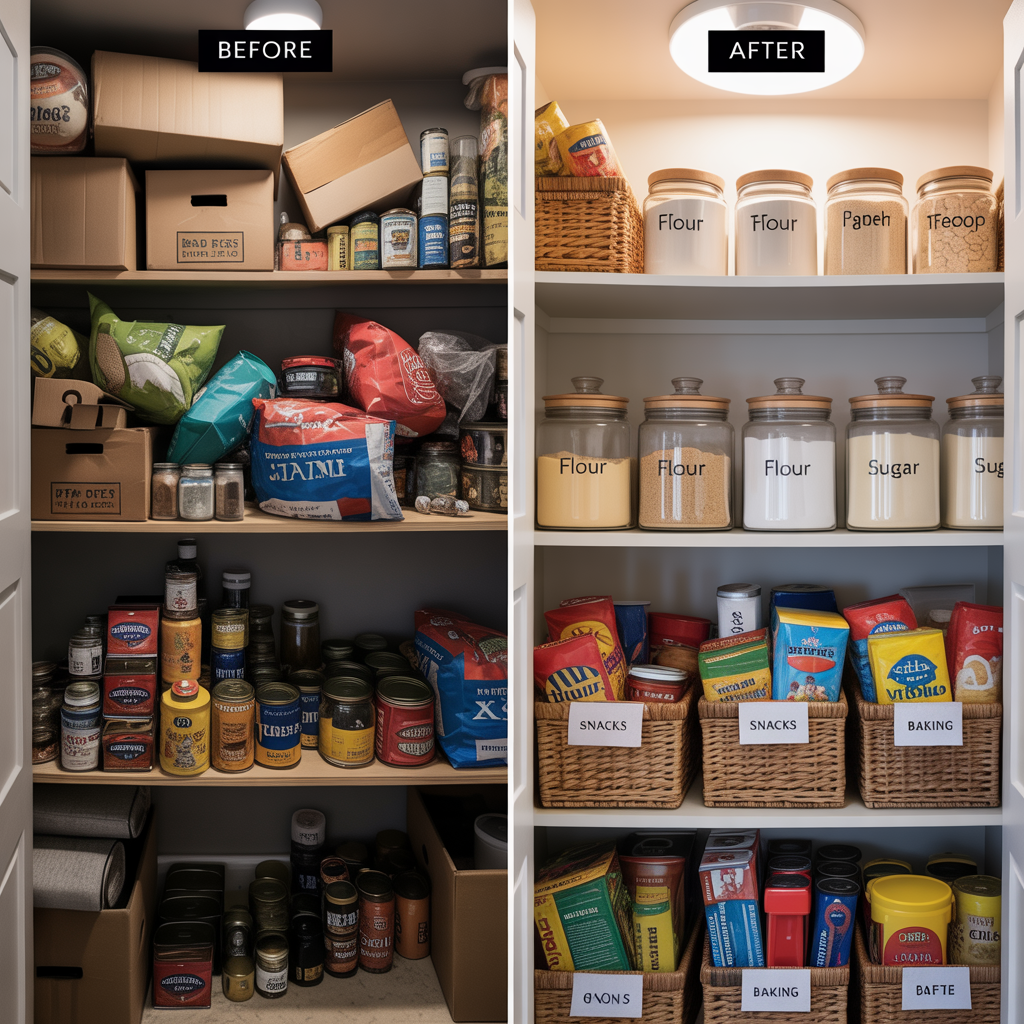
You open your pantry door and are greeted by a wall of visual noise. Boxes are crammed next to bags, cans are hidden behind other cans, and somewhere in the back, a half-used bag of lentils from six months ago likely resides.
You know there is “food” in there, but the simple question, “What can I make for dinner?”, requires a complex mental calculation. You have to recall what you bought last week, guess at quantities, and hope that the sauce you need isn’t expired. This daily mental gymnastics is exhausting.
This invisible effort is known as mental load—the constant, background cognitive work of managing the endless details of a household. And your cluttered pantry and refrigerator are two of the biggest contributors to this daily drain.
Every item hidden from view is an item you are forced to track in your brain. But what if you could outsource that job? What if you could transform your food storage spaces from chaotic messes into clear, at-a-glance dashboards?
This guide will introduce you to The “Visual Inventory” Technique, a powerful system for redesigning your pantry and fridge. This is not about achieving a Pinterest-perfect aesthetic.
It is a science-backed method designed to drastically reduce mental load, prevent food waste, and make every aspect of feeding yourself and your family—from grocery shopping to cooking—infinitely easier.
The Science of Mental Load: Why Your Cluttered Pantry is Draining Your Brain
To understand why this system is so effective, we must first understand the problem it solves.
Defining “Mental Load” (Carga Mental): The Invisible To-Do List
Mental load is the “thinking work” behind the “doing work.” It’s the constant, running spreadsheet in your head that tracks inventories, remembers schedules, and anticipates future needs. It’s not just cooking dinner; it’s the process of remembering you have chicken, realizing it needs to be thawed, checking if you have onions, and adding pasta to the shopping list. This invisible labor is a significant source of chronic stress and burnout.
Your Brain’s Working Memory Bottleneck
Think of your brain’s working memory like the RAM on a computer. It has a finite, and surprisingly small, capacity for holding and processing information at any one time. A cluttered pantry forces your brain to run multiple background processes simultaneously:
process1 = "Remember we have two cans of tomatoes, but one might be diced."process2 = "Guess how much rice is left in that opaque box."process3 = "Try to recall if the baking powder is expired."This clogs your mental RAM, leaving you with less capacity for creative thinking, problem-solving, and being present with your family.
How Visual Clarity Reduces Cognitive Strain
The human brain is a visual supercomputer. It can process images and visual patterns thousands of times faster than it can process text or recall abstract information from memory. A “visual inventory” system is designed to leverage this strength. It outsources the job of “remembering” to your eyes. You no longer have to remember that you have chickpeas; you can instantly see that you have two jars. The mental task is offloaded to the environment.
The “Visual Inventory” Makeover: A Step-by-Step Guide to Clarity
This project is best tackled over a weekend. The upfront effort is significant, but the long-term payoff in mental peace is immeasurable.
Phase 1: The Great Empty & Ruthless Edit
Take Everything Out: This is the most intimidating but most crucial step. Empty every single item from your pantry shelves onto your kitchen table or counter.
A Moment of Truth from C. Holmes “For years, my own pantry was what I’d call ‘controlled chaos.’ I knew where most things were, more or less. The turning point for me was the day I bought a third jar of cumin, only to later find two half-used ones hidden behind a box of crackers. It was a small thing, but it was a clear signal: my disorganization was costing me real money. The decision to pull everything out and face the mess was daunting, but it was the necessary first step to creating a system that actually worked.”
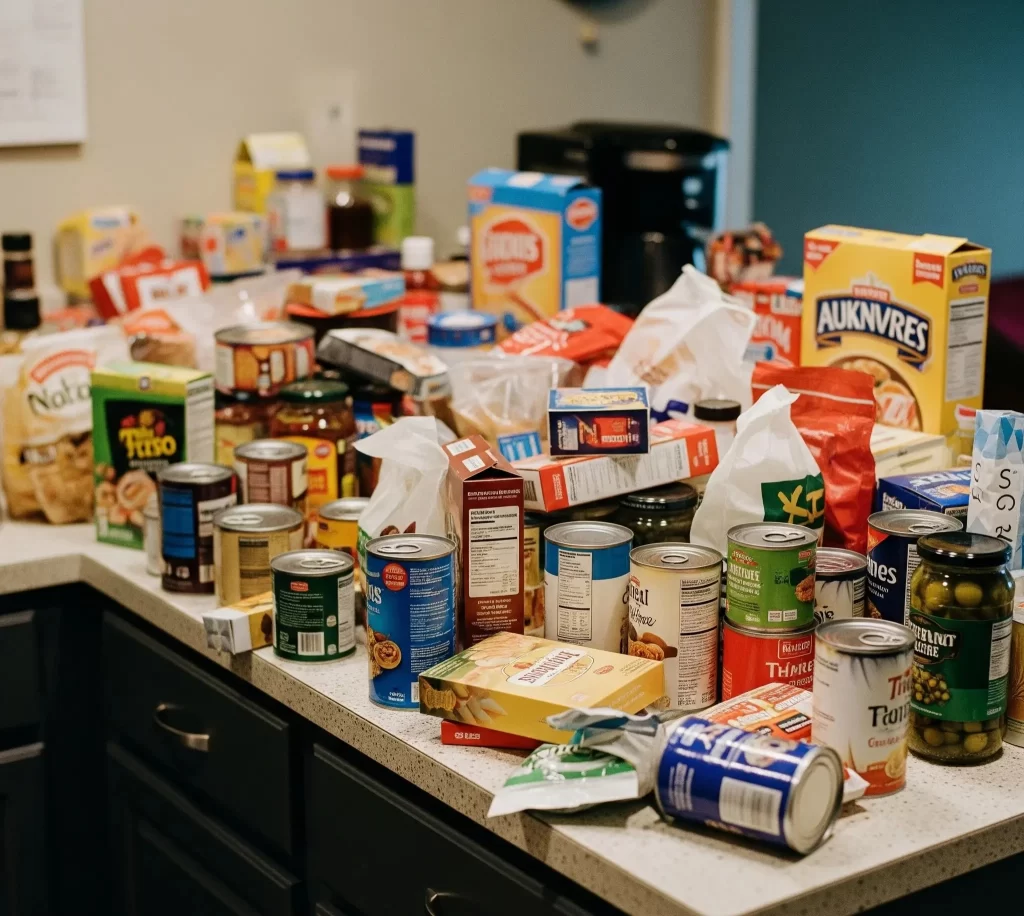
- Clean the Canvas: With the pantry completely empty, give it a thorough cleaning. Wipe down the shelves and walls. You are creating a clean slate.
- Group and Edit: As you took items out, you should have started grouping them into broad categories: grains, pastas, canned goods, baking supplies, snacks, spices, etc. Now, go through each item in a category and be ruthless.
- Check Expiration Dates: Immediately discard anything that is expired.
- Be Honest: Will you really use that tin of smoked oysters you bought for a party two years ago? If not, donate it if it’s still in date. Be honest about your family’s actual eating habits.
Phase 2: Decanting & Containment (Creating Visual Logic)
This is where the magic happens. You will now move items from their chaotic commercial packaging into a uniform, clear system.
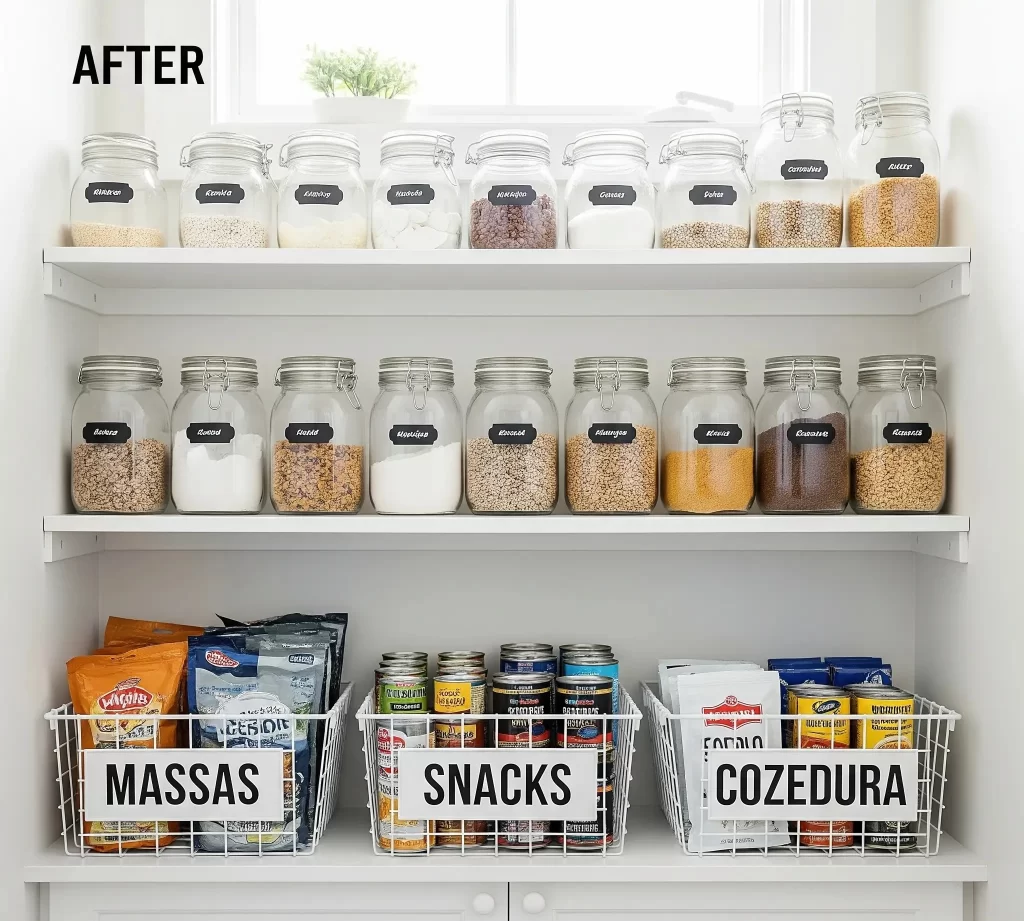
- The Power of Decanting: The single most effective action you can take is to decant dry goods like flour, sugar, rice, pasta, oats, and cereal into clear, airtight containers. This achieves two things: it keeps food fresher for longer, and it makes the quantity instantly visible. You will never again have to guess how much flour you have left.
C. Holmes’s Most Controversial Tip “My most effective, and sometimes most resisted, piece of advice is this: take your dry goods out of their original packaging. Yes, it takes an extra ten minutes after you get home from the ‘supermercado’. But the cognitive payoff is immense. The ability to see exactly how much rice you have with a single glance, instead of mentally guessing the weight of a half-empty box, is a permanent upgrade to your kitchen’s operating system. It’s a one-time investment for a daily return of mental clarity.”
- Choose Your Containers: You don’t need to spend a fortune.
- Budget-Friendly: Simple glass jars (you can save and reuse pasta sauce or coffee jars for a rustic look), or clear plastic food storage containers.
- Mid-Range: A set of OXO-style pop-top containers or other modular, stackable clear containers. The key is uniformity and transparency.
- The Magic of Bins and Baskets: For items that cannot be decanted (like sauce packets, small bags of chips, or canned goods), use open-top bins or baskets to corral them. This creates a “drawer” on your shelf. You can pull out the entire “Baking” bin to find your vanilla extract, rather than hunting for it behind the cans. Label each bin clearly.
Phase 3: Strategic Placement (Designing for Flow)
- The “Prime Real Estate” Principle: The shelf at eye level is your most valuable real estate. Place your most frequently used items here (e.g., olive oil, salt, everyday grains).
- Zoning by Category: Arrange your pantry in logical zones using the bins and containers. Put all baking supplies together. All pastas and grains together. All canned goods together. This is like creating a map of your pantry.
- First-In, First-Out (FIFO): When you buy a new bag of rice, don’t just put it in front of the old one. Pour it into your decanted container to top it off, or if using bins, place the new item at the back of the row. This simple habit, borrowed from retail, ensures you always use the oldest items first.
Applying the Visual Inventory System to the Refrigerator
The fridge presents a unique challenge due to high turnover and oddly shaped items, but the principles remain the same.
- Fridge Zoning is Key: Designate specific homes. The door is the warmest part, so it’s best for less-perishable condiments. Use one crisper drawer for vegetables and the other for fruits. The top shelf is great for leftovers and drinks. The colder, lower shelves are better for raw meat or dairy.
- Use Clear Bins: This is a refrigerator game-changer. Use clear, stackable fridge bins to group items. Have a “Yogurts” bin, a “Cheeses” bin, a “Snacks” bin. This prevents small items from getting lost in the back and allows you to pull out a whole category at once.
- The “Eat Me First” Box: This is the single best trick to reduce food waste. Designate one clear bin, placed in a prominent, eye-level spot. Anything that needs to be used up soon—half a bell pepper, leftover chicken, yogurt nearing its expiration date—goes into this box. It becomes a visual cue for the whole family: “When looking for a snack, check here first.”
Frequently Asked Questions (FAQ)
- Buying all those matching containers seems expensive and not very eco-friendly. Are there budget/sustainable options?
- Absolutely. You do not need to buy expensive containers. Start by saving and thoroughly cleaning glass jars from pasta sauce, coffee, pickles, and jam. They are free, glass is infinitely recyclable, and they create a beautiful, rustic, and uniform look. For bins, simple, inexpensive plastic baskets from a “loja de 1,99” work just as well as high-end ones.
- How do I remember the cooking instructions or expiration dates once I’ve thrown away the packaging?
- This is a great question. For cooking instructions (like the water-to-grain ratio for quinoa), use a small piece of masking tape or a chalk marker on the bottom or back of the container to write down the instructions. For expiration dates, you can do the same, or simply practice the FIFO (First-In, First-Out) method to ensure you’re always rotating your stock.
- I have a very small, deep pantry. How can I make things at the back “visual”?
- Deep pantries are a challenge. The solution is to use bins and turntables (lazy susans). Grouping items in a long, narrow bin allows you to slide the whole bin out like a drawer to see what’s in the back. A lazy susan is perfect for corner cabinets or deep shelves, allowing you to spin it to bring items from the back into view.
- This seems like a huge amount of work upfront. How long will it take, and is it really worth it?
- Be prepared for the initial setup to take 2-4 hours, depending on the size of your pantry. It is a significant one-time investment. However, the payoff is daily and long-lasting. You will save time every single day when you cook, make a grocery list, and put groceries away. You will save money by reducing food waste and not buying duplicate items. Most importantly, you will save a tremendous amount of mental energy. It is absolutely worth it.
- My family members mess up the system as soon as I organize it. How can I get them on board?
- The key is to make the system intuitive and easy to use. Clear labels are non-negotiable. If everyone knows where the “Snacks” bin is, they are more likely to use it. Involve them in the initial setup process. Ask them where it makes sense to store certain items. When the whole family has a hand in creating the system, they are more likely to feel a sense of ownership and help maintain it.
The Calm of a Clear View
A Visual Inventory is not truly about aesthetics; it is a powerful interface for your brain. It is a functional, cognitive tool disguised as an organized pantry. By transforming chaotic spaces into clear, visual dashboards, you are systematically removing a significant source of daily mental load. Every time you open a cabinet and instantly see what you have, you reclaim a small piece of your mental energy. You are not just organizing your food; you are organizing your thoughts. This is the profound connection between our external environment and our internal peace, and it is the foundation of a truly Intentional Home.

C. Holmes is the keen analytical mind behind Infinitas Minds, a blog dedicated to revolutionizing the way we approach home economics. With a meticulous eye for detail and a passion for logical solutions, C. Holmes tackles everyday challenges to reveal hidden opportunities for efficiency and savings. His mission is to simplify life, spark innovation, and offer practical, insightful approaches for navigating our often-complex world with greater ease and financial clarity.
Driven by a belief that true mastery of home economics lies in understanding the ‘why’ and ‘how’ behind every decision, C. Holmes curates comprehensive guides, actionable experiments, and groundbreaking perspectives. Expect a blend of sharp analysis, creative problem-solving, and a touch of ingenuity in every piece, empowering readers to transform their homes into havens of efficiency and peace.