
You’ve seen the beautiful, color-coded meal planning templates on Pinterest. You’ve read the articles extolling the virtues of a perfectly prepped week of meals. You’ve probably even tried it yourself—spending a Sunday afternoon meticulously planning seven distinct dinners, shopping for a mountain of ingredients, only to have your entire rigid structure collapse by Wednesday when a late meeting or sheer exhaustion derails your ambition.
You end up ordering a pizza, the carefully purchased kale wilts in the fridge, and a familiar feeling of failure sets in. You conclude, once again, that you are just not a “meal planning person.”
I am here to tell you that the problem isn’t you; it’s the system. Traditional, rigid meal planning is a system designed for a perfect, predictable life that very few of us actually lead. It doesn’t account for spontaneity, exhaustion, or sudden cravings.
For most of us, it’s a recipe for guilt. So, what if we threw out the rulebook? What if we created an “anti-meal plan”—a system designed not for a perfect life, but for your real life?
This guide will introduce you to the 3-3-1 Formula, a simple, flexible, and powerful system designed specifically for people who hate meal planning. We will explore the psychology of why rigid plans fail and build a new framework that prioritizes flexibility, reduces decision fatigue, and finally makes peace with the reality of a busy week. This is your path to reclaiming your evenings without sacrificing your sanity or your budget.
The Psychology of the Failed Plan: Why Rigidity is the Enemy
To build a better system, we must first diagnose why the old one consistently fails.
The Perfectionism Trap
Traditional meal planning often triggers our inner perfectionist. We feel compelled to plan seven unique, healthy, and impressive meals. This “all-or-nothing” thinking means that the moment we deviate—the moment we don’t feel like making the planned salmon on Tuesday—we perceive the entire week’s plan as a failure and abandon it completely.
The Overestimation of Future Energy
On a calm Sunday afternoon, we are notoriously bad at predicting our energy levels for a frantic Wednesday evening. We plan an ambitious meal that requires 45 minutes of chopping and multiple pans, failing to account for the reality of a draining workday. When Wednesday arrives, our depleted willpower defaults to the easiest possible option, which is rarely the one on the spreadsheet. This is a core concept we explore in our guide to Decision Fatigue.
The Illusion of Control
Life is unpredictable. A friend might suggest a spontaneous dinner out. You might have to work late. You might simply not be in the mood for what “Sunday You” dictated “Thursday You” must eat. A rigid plan shatters upon contact with real life, whereas a flexible system can adapt.
The 3-3-1 Formula: A Framework for Flexibility
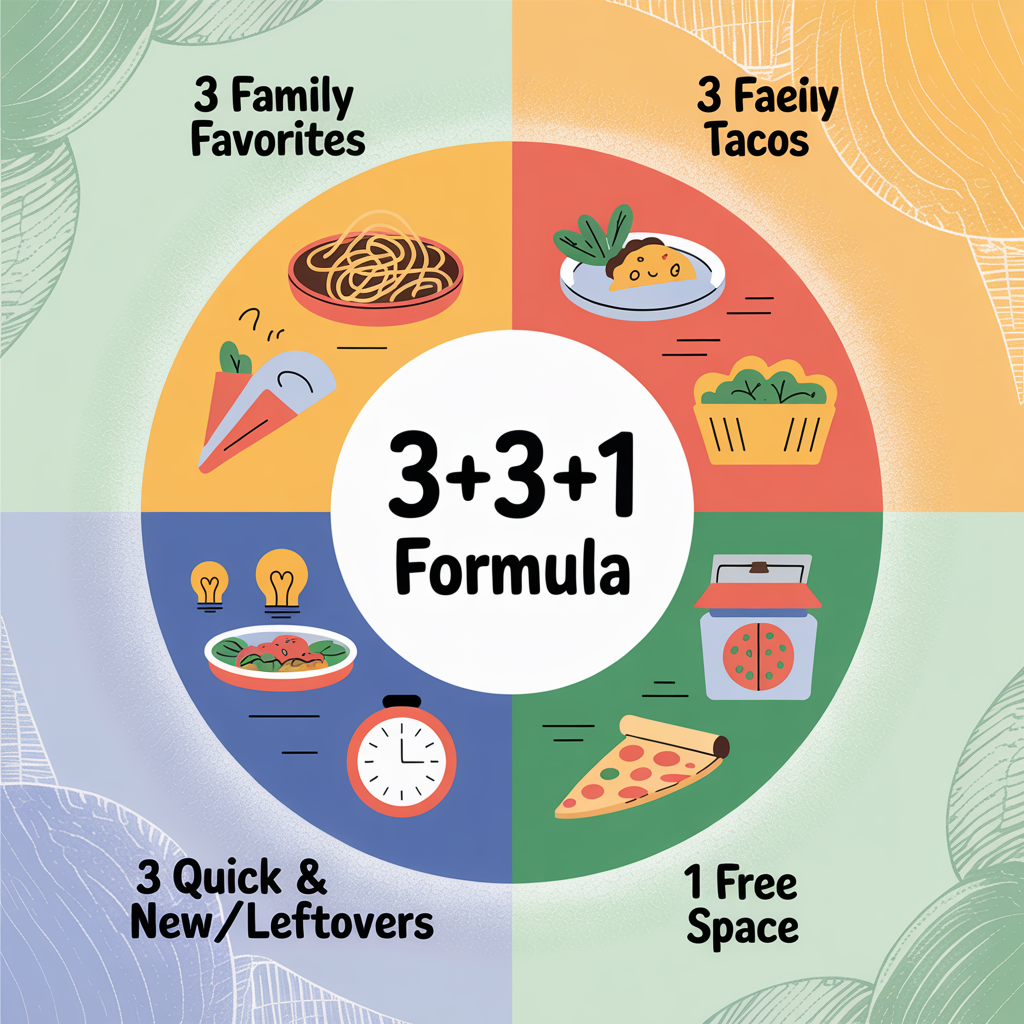
The 3-3-1 Formula is not a meal plan; it is a meal planning system. It provides structure without being a straitjacket. The goal is to plan for your week of seven dinners by making only three core decisions.
The Core Formula Defined
For your seven-day week, you will plan:
- 3x Familiar Favorites: These are your “no-brainer” meals. The dishes you know by heart, that you enjoy, and that you can cook on autopilot.
- 3x Quick & New (or Leftovers): This category is for flexibility. It can be three new, simple recipes you want to try, or it can be three nights designated for leftovers, or a mix of both. The key is that they are low-effort.
- 1x “Free Space”: This is your built-in permission to be human. It’s your designated night for takeout, a dinner out with friends, or a simple “fend for yourself” night with scrambled eggs or a sandwich.
Why This System Works
- It Drastically Reduces Decision Fatigue: Instead of making seven unique decisions, you are making three broad ones. You don’t need to assign each meal to a specific day yet. You are simply creating a “menu” of options for the week.
- It Balances Reliability and Novelty: The “Familiar Favorites” provide a comforting, reliable core. The “Quick & New” category satisfies the desire for variety without the pressure of a complex recipe.
- It Builds in Failure: The “Free Space” is the most crucial element. By planning for a night off, you eliminate the guilt associated with not cooking. It acknowledges that life happens, and it makes the entire system more resilient and sustainable.
Implementing the 3-3-1 Formula: A Step-by-Step Guide
Here’s how to integrate this into your Sunday Reset Routine.
Step 1: Brainstorm Your Categories (10 Minutes)
Sit down with a piece of paper or a digital note.
- List Your “Familiar Favorites”: What are 5-10 meals your household loves and you can cook easily? (e.g., Spaghetti Bolognese, Roast Chicken and Veggies, Tacos, Frittata). For your first week, choose three from this master list.
- List Your “Quick & New” Ideas: What are some low-effort options? (e.g., “try that 20-minute sausage pasta recipe,” “sheet-pan gnocchi,” “big salad with grilled chicken”). Or simply designate them as “Leftover Nights.” Choose three for the week.
- Designate Your “Free Space”: Decide which night is most likely to be your takeout or spontaneous night. Often, this is Friday or Saturday.
Your plan for the week might look this simple:
- Favorites: Tacos, Roast Chicken, Frittata
- Quick/New: Leftovers, Leftovers, Sheet-Pan Gnocchi
- Free Space: Friday Pizza Night
Step 2: Create Your “Menu” Grocery List (10 Minutes)
Now, based on that simple menu, create your grocery list. This is far less intimidating than shopping for seven completely different recipes. You’ll notice ingredient overlap (e.g., onions and peppers for both the tacos and the gnocchi), which streamlines your shopping and reduces waste. This is a core principle of a Smart Shopper’s Blueprint.
Step 3: The Daily “What’s for Dinner?” Micro-Decision
Each morning, or when you get home from work, you look at your menu of six available meals (3 Favorites, 3 Quick/New). Now, you ask yourself a much simpler question: “Of these six options, what do I have the time and energy for tonight?”
- Had a long, stressful day? Choose a Leftover Night or the super-easy Frittata.
- Feeling a bit more energetic? Make the Roast Chicken, knowing you’ll have leftovers for another night.
- This daily, flexible choice is what makes the system work. You are always choosing from a pre-approved, pre-shopped list, which eliminates the stress of the wide-open “what should I eat?” question.
Advanced Tips for the 3-3-1 Practitioner
- The “Cook Once, Eat Twice” Principle: Make your “Familiar Favorites” work for you. When you make Roast Chicken, roast extra vegetables. The leftover chicken and veggies can become the base for a “Big Salad” on a Quick & New night.
- The “Theme Night” Variation: If you want a little more structure, you can combine the 3-3-1 Formula with theme nights. Your “Familiar Favorites” could be your go-to recipes for “Pasta Night,” “Taco Tuesday,” etc.
- Building Your Recipe Arsenal: Keep a running list of successful “Familiar Favorites” and “Quick & New” recipes. Over time, this becomes your personal cookbook, making the weekly brainstorming session even faster.
Frequently Asked Questions (FAQ)
- This doesn’t feel like a “plan.” How do I know I’ll have the right ingredients if I don’t assign meals to specific days?
- You will have the right ingredients because you shopped for all six meals at the beginning of the week. Your fridge contains the components for your entire “menu.” The only risk is if fresh produce for one meal might go bad before you use it. To mitigate this, simply try to use the meals with the most perishable ingredients (like fresh fish or leafy greens) earlier in the week.
- What if I only want to cook two times a week? How can I adapt this?
- Easily. Your formula could be “2-4-1”: 2 Familiar Favorites (that you make in large batches), 4 Leftover Nights, and 1 Free Space. The formula is a flexible framework, not a rigid rule. Adapt the numbers to your lifestyle.
- How does this system help with budgeting and reducing food waste?
- It helps immensely. By shopping from a focused list for just six meals, you drastically reduce impulse buys. By planning for leftover nights, you ensure that the food you cook gets eaten. The “Free Space” also helps your budget by making takeout an intentional, planned expense rather than a frequent, last-minute panic purchase.
- I’m cooking for one. How does this work?
- It works brilliantly. You might cook one “Familiar Favorite” on Sunday, which provides leftovers for two “Quick & New” nights. Then you might cook one more simple meal mid-week, which provides another leftover. Your formula could be “2-3-2”: 2 cooking nights, 3 leftover nights, and 2 free spaces.
- My biggest problem is finding the motivation to do the planning on Sunday. Any tips?
- This is where habit-stacking from our guide to The One-Touch Rule can help. Link your 20-minute meal planning session to an existing Sunday habit. For example: “After I have my second cup of coffee on Sunday morning, I will immediately sit down and do my 3-3-1 plan.” Also, remember the feeling of weeknight dinner panic. You are investing 20 minutes of calm on Sunday to avoid 30 minutes of stress every single weeknight. It’s a fantastic return on investment.
The Freedom of a Flexible Framework
The goal of a successful home system is not to force your messy, unpredictable life into a perfect, rigid box. The goal is to create a framework that is strong enough to support you but flexible enough to bend with the realities of your life. The 3-3-1 Formula is your framework for food. It frees you from the tyranny of the daily dinner decision and the guilt of the failed, overly ambitious meal plan. It is an act of kindness to your future self. By embracing this “anti-plan,” you are not abandoning structure; you are adopting a smarter, gentler, and ultimately more sustainable one. You are making space in your life for what truly matters, confident in the knowledge that dinner, at least, is already handled.

C. Holmes is the keen analytical mind behind Infinitas Minds, a blog dedicated to revolutionizing the way we approach home economics. With a meticulous eye for detail and a passion for logical solutions, C. Holmes tackles everyday challenges to reveal hidden opportunities for efficiency and savings. His mission is to simplify life, spark innovation, and offer practical, insightful approaches for navigating our often-complex world with greater ease and financial clarity.
Driven by a belief that true mastery of home economics lies in understanding the ‘why’ and ‘how’ behind every decision, C. Holmes curates comprehensive guides, actionable experiments, and groundbreaking perspectives. Expect a blend of sharp analysis, creative problem-solving, and a touch of ingenuity in every piece, empowering readers to transform their homes into havens of efficiency and peace.