
“I don’t have time.” It is the most common, most relatable, and most powerful excuse of modern life. We say it to ourselves when we look at the pile of laundry, when we think about cooking a healthy meal, when we consider starting a new hobby.
We feel perpetually busy, constantly in motion, yet we end our days with a nagging feeling of unproductivity and a home that feels just as chaotic as it did in the morning. We are time-poor, and it’s a profound source of stress. But what if I told you that you likely have more time than you think? You just don’t know where it’s going.
The problem is not a lack of hours in the day, but a lack of data. You wouldn’t manage your finances without looking at your bank statement, so why do we try to manage our most precious, non-renewable resource—our time—based on vague feelings and assumptions? It’s time to stop guessing and start measuring. This guide will walk you through the process of conducting a personal time audit.
This is not about shaming yourself or becoming a productivity robot. This is a neutral, judgment-free diagnostic tool designed to give you an honest, data-driven picture of your life.
It is the most powerful first step you can take to move from feeling chronically busy to feeling intentionally productive. Welcome to the most eye-opening experiment in The Intentional Home.
The Fallacy of “Felt Time”: Why We Are Terrible at Estimating
Before we begin, we must accept a fundamental truth: our perception of time is incredibly unreliable. Psychologists call this “time perception bias.”
The Dopamine Distortion
Activities that provide a steady stream of dopamine and novelty, like scrolling through social media or watching a series of short videos, cause our brains to underestimate the passage of time. A “quick five-minute check” on Instagram can easily turn into 45 minutes without us consciously registering it. The brain is having fun, so it loses track.
The Chore Contraction
Conversely, activities we find boring or effortful, like washing dishes or folding laundry, are often perceived as taking much longer than they actually do. Our brain wants the task to be over, so every minute feels stretched. You might avoid folding a basket of laundry because you feel it will take “forever,” when in reality, it’s a 12-minute task.
A time audit bypasses these feelings and biases. It replaces “I feel like I spend about…” with “The data shows I spent exactly…”. This clarity is the foundation of all effective change.
How to Conduct a Personal Time Audit: The 3-Day Data Collection
The goal is to track your time for a short, representative period. A full 3-day period—for example, a Thursday, a Friday, and a Saturday—is ideal as it gives you a picture of a late weekday, the end of the work week, and a weekend day.
Choose Your Tracking Tool
- Analog Method (The Notebook): Simple and effective. Carry a small notebook and a pen with you everywhere. The physical act of writing can make you more mindful of the process.
- Digital Method (The Spreadsheet): Create a simple spreadsheet with time blocks (e.g., in 15- or 30-minute increments) and columns for each day. This makes analysis easier later.
- App Method (The Tracker): Use a time-tracking app like Toggl, Clockify, or Harvest. These apps allow you to create categories and simply tap to start and stop timers for different activities.
The Rules of Engagement: Honesty and Granularity
- Track in Real-Time (or Close to It): Do not try to remember what you did hours ago. Log your activity as you switch tasks, or at least every 30-60 minutes. Set a recurring alarm on your phone if you need a reminder.
- Be Brutally Honest and Specific: This is a judgment-free zone. If you spent 25 minutes scrolling through TikTok, write down “Scrolling TikTok,” not “Taking a break.” If you spent 40 minutes staring into the fridge trying to decide what to eat, write that down. The more honest you are, the more useful the data will be.
- Don’t Change Your Behavior (Yet): For these three days, try to live your life as you normally would. The goal is to capture a baseline of your typical habits, not your ideal ones.
Example Log Entry (Notebook Method):
- 7:00 – 7:15: Woke up, scrolled news on phone in bed.
- 7:15 – 7:45: Showered, got dressed.
- 7:45 – 8:15: Made and ate breakfast, unloaded dishwasher.
- 8:15 – 8:30: Searched for lost keys, packed bag.
- 8:30 – 9:30: Commute to work (listening to podcast).
The Analysis Phase: Finding the Patterns and “Time Leaks”
After your 3-day tracking period, it’s time to become a data analyst. This is where the insights happen.
Step 1: Categorize Your Time
Go through your log and assign each entry to a broad category. Use a highlighter or create columns in your spreadsheet. Your categories might include:
- Work/Commute
- Sleep
- Essential Home Care (cooking, basic cleaning)
- Personal Care (showering, exercise)
- Family/Partner Time
- Errands/Life Admin
- Relaxation/Hobbies (reading, watching a movie with intention)
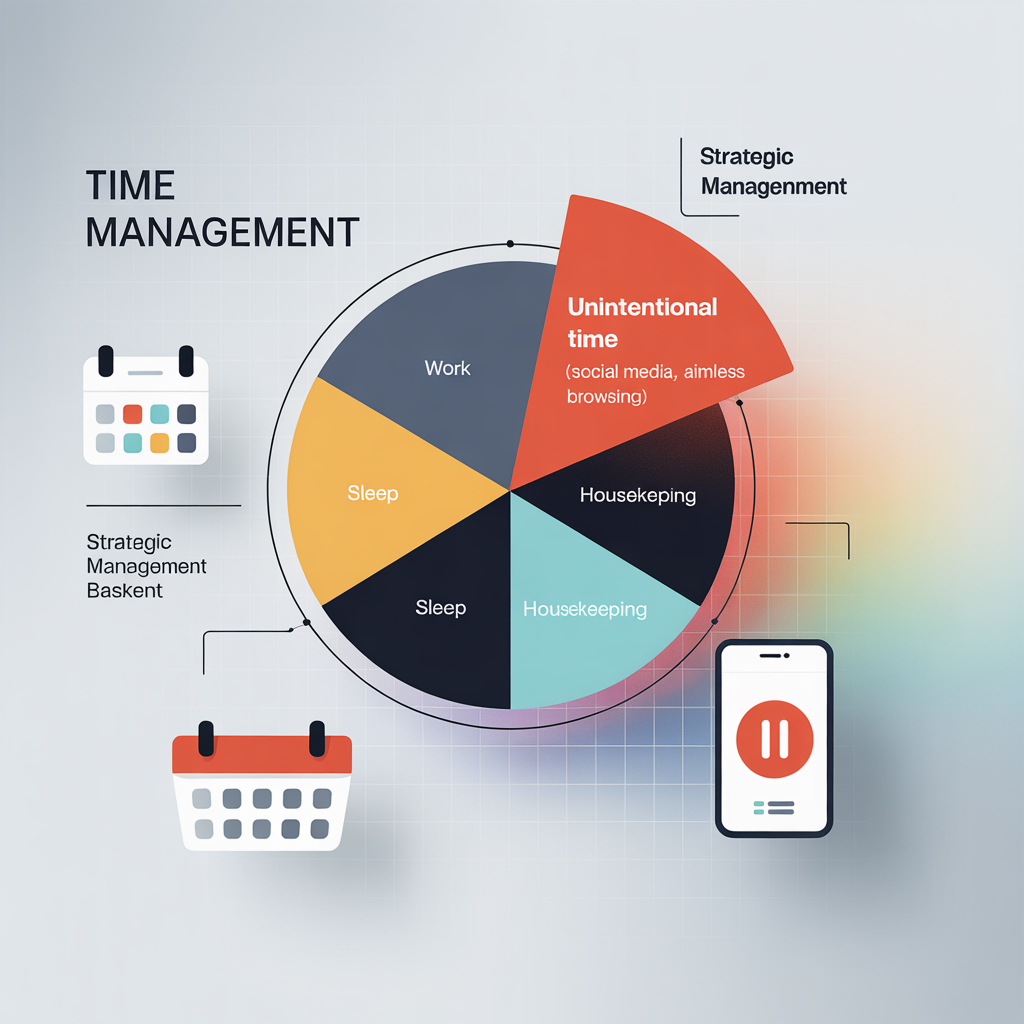
- Unintentional Time (social media scrolling, channel surfing, aimless web Browse)
Step 2: Ask the Tough Questions
Now, look at your totals for each category. This is where the eye-opening moments occur.
- The Surprise Factor: What is the biggest surprise? Most people are shocked by the total amount of time spent in the “Unintentional Time” category. That “quick check” on social media often adds up to 2+ hours a day.
- The “Transition Time” Leak: How much time is spent between tasks? Time spent “deciding what to do next” or gathering supplies for a task is a major time leak.
- The Misalignment Question: Look at your categories. Does this breakdown align with your values and priorities? If you say “family time is my top priority” but the data shows you spend more time on social media than with your family, that misalignment is a powerful motivator for change.
- The Energy Level Analysis: Look at when you do certain tasks. Are you trying to do high-energy tasks (like a big cleaning project) at the end of the day when your energy is lowest?
The Strategic Phase: Reclaiming and Reallocating Your Time
Data is useless without action. Here is how to use your findings to build a better week.
Strategy 1: Target Your Biggest “Time Leak”
For most people, this is unintentional screen time. The goal is not to eliminate it, but to make it intentional. Instead of grabbing your phone whenever you have a spare moment, schedule it. Say, “I will allow myself 20 minutes of guilt-free social media scrolling after I finish my Closing Shift Routine.” This turns a time leak into a planned reward.
Strategy 2: Implement “Time Blocking”
Now that you know where your time goes, you can be the architect of your day. Time blocking is the practice of scheduling your to-do list directly onto your calendar.
- Instead of a to-do list that says “Do laundry,” your calendar for Saturday will have a specific block from 10:00 AM to 11:00 AM labeled “Weekly Laundry.”
- This combats procrastination and decision fatigue. At 10:00 AM, you don’t have to decide what to do; your calendar has already made the decision for you.
Strategy 3: The Power of “Batching”
Look at your audit. Did you make three separate trips to different stores during the week? Did you pay bills on four different days? Batching means grouping similar tasks together.
- Errand Batching: Consolidate all your weekly errands into one efficient trip on a specific day.
- Life Admin Batching: Designate one hour every Sunday (as part of your Sunday Reset) to pay all bills, answer all non-urgent personal emails, and make any necessary appointments for the week.
Frequently Asked Questions (FAQ)
- This sounds like a lot of work. Is tracking my time really worth the effort?
- The tracking itself is a short-term investment (just 3 days) for a massive long-term payoff. You cannot effectively manage a resource you do not measure. The clarity you will gain from this simple exercise is the single most powerful catalyst for changing your relationship with time.
- What if I have a very unpredictable job or life with kids? How can I possibly track my time accurately?
- The goal is not perfection, but a “good enough” picture. If your day is chaotic, track in broader strokes. Instead of 15-minute increments, maybe you use 30- or 60-minute blocks. The key is to capture the general flow. Even a “messy” time audit will reveal major patterns you were previously unaware of.
- I’m afraid to do this because I think I’ll feel really guilty and ashamed about how I spend my time. How do I get over that?
- This is a crucial point. You must enter this process with the mindset of a neutral scientist observing data, not a judge delivering a verdict. There is no “good” or “bad” way to spend time; there is only alignment and misalignment with your goals. The data is not there to make you feel bad; it’s there to empower you to make changes if you want to.
- I did the audit and discovered I have almost no free time at all. It just confirmed I’m too busy. Now what?
- This is also a valuable finding. If your audit shows that every single hour is packed with work, commuting, and essential care tasks, it provides you with the data you need to address bigger issues. It might be the catalyst to talk to your boss about your workload, to discuss a more equitable division of labor with your partner, or to investigate outsourcing a task (like hiring a cleaner once a month) to buy back some time.
- How often should I do a time audit?
- A full 3-day audit is a fantastic diagnostic tool to do once or twice a year, or whenever you feel your life has fallen out of balance. For maintenance, you can do a much simpler “one-day audit” every month just to check in and see if your systems are still working and your time is aligned with your priorities.
Becoming the Architect of Your Days
The personal time audit is a revolutionary act of self-awareness. It pulls back the curtain on the story you’ve been telling yourself about your time and replaces it with the undeniable truth of data. You are no longer a passive victim of a “busy” life; you are the architect of your days, equipped with the knowledge to make intentional, powerful choices. You will discover that you do not need more hours in the day. You simply need to be more mindful of how you invest the ones you already have. By reclaiming even one “lost” hour a day from unintentional activities, you gain seven hours a week—more than enough time to create a home and a life that feels less chaotic and more deeply, authentically yours.

C. Holmes is the keen analytical mind behind Infinitas Minds, a blog dedicated to revolutionizing the way we approach home economics. With a meticulous eye for detail and a passion for logical solutions, C. Holmes tackles everyday challenges to reveal hidden opportunities for efficiency and savings. His mission is to simplify life, spark innovation, and offer practical, insightful approaches for navigating our often-complex world with greater ease and financial clarity.
Driven by a belief that true mastery of home economics lies in understanding the ‘why’ and ‘how’ behind every decision, C. Holmes curates comprehensive guides, actionable experiments, and groundbreaking perspectives. Expect a blend of sharp analysis, creative problem-solving, and a touch of ingenuity in every piece, empowering readers to transform their homes into havens of efficiency and peace.