You end a long day with the best of intentions. Tonight, you’ll read a chapter of that book you’ve been meaning to finish. You’ll skip the late-night snacks. You’ll go to bed early. But then you sit on the couch. The remote control is right there. The cookies are on the counter in a clear glass jar.
Your phone, buzzing with notifications, is in your pocket. An hour later, you find yourself deep into a new series, surrounded by cookie crumbs, endlessly scrolling. Your good intentions have evaporated, defeated once again by the path of least resistance.
We have been taught to believe that changing our behavior is a matter of pure willpower and self-discipline. We believe that to break bad habits, we must simply be stronger. This approach is not only largely ineffective; it’s exhausting. It’s like trying to swim upstream against a powerful current. What if, instead of fighting the current, you could simply redirect the river?
This is the power of environmental design. This guide will introduce you to “friction”—the invisible force that shapes your daily choices. You will learn that you can be the architect of your own habits, strategically redesigning your home environment to make good habits almost effortless and bad habits a genuine hassle. Forget willpower. It’s time to become a behavioral architect.
The Science of Automaticity: Your Brain on Autopilot
To understand why this strategy works, you need to understand that most of your daily actions are not conscious choices. They are habits.
The Habit Loop: Cue, Routine, Reward
As detailed in books like “The Power of Habit” by Charles Duhigg, every habit follows a simple neurological loop:
- Cue: A trigger in your environment that tells your brain to go into automatic mode. (Example: Seeing the cookie jar on the counter).
- Routine: The physical or emotional action you perform. (Example: Grabbing and eating a cookie).
- Reward: The feeling of satisfaction that tells your brain this loop is worth remembering. (Example: The delicious hit of sugar).
Our environments are saturated with cues that trigger our routines, both good and bad.
The Principle of Least Effort
Human beings are biologically wired to conserve energy. This is a survival mechanism. When presented with multiple options, our brain will almost always default to the one that requires the least amount of physical and mental effort.
The path of least resistance is the path most traveled. The cookie on the counter requires less effort to obtain than the apple in the refrigerator’s crisper drawer. This isn’t a moral failing; it’s physics.
Defining “Friction”
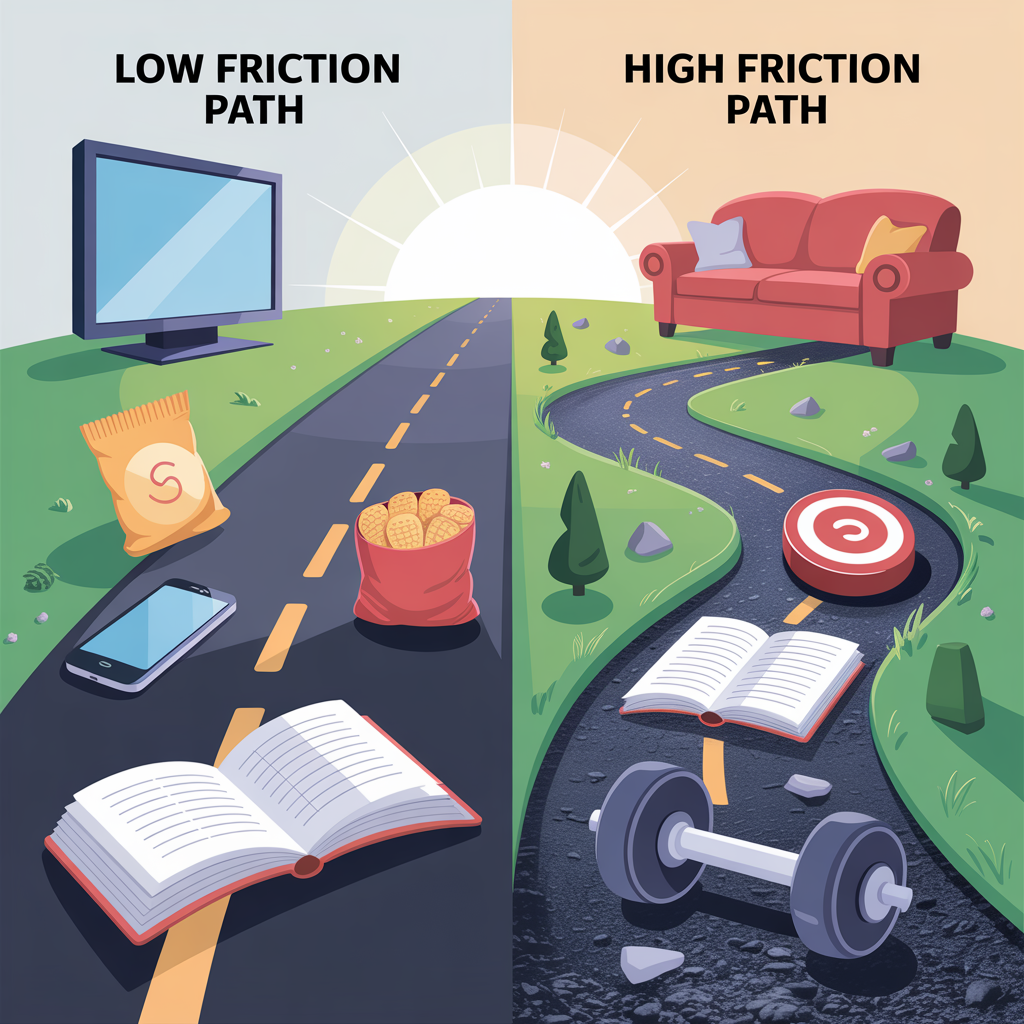
In the context of habit formation, friction is any obstacle, no matter how small, that makes an action more difficult to perform. It can be time, physical distance, extra steps, or mental effort. The genius of environmental design is understanding that you have complete control over the friction associated with your habits.
Increasing Friction: Making Bad Habits More Difficult
The key to breaking a bad habit is not to “just stop.” It’s to make the habit so inconvenient that your brain’s natural laziness works for you, not against you.
The Habit: Mindless Late-Night Snacking
- The Low-Friction Path (Default): A bag of chips sits in the pantry at eye level. Cookies are in a clear jar on the counter. Ice cream is at the front of the freezer.
- The High-Friction Redesign:
- Hide the Cues: Move the cookies to an opaque container on the highest shelf in the pantry, forcing you to get a step-stool.
- Add Steps: Buy snacks in individual portions rather than a large bag, forcing you to make a conscious decision to open another one.
- Increase Distance: The ultimate friction is to simply not buy the junk food in the first place. If it’s not in the house, the effort required to get it (going to the store) is immense.
The Habit: Excessive Phone & Social Media Use
- The Low-Friction Path (Default): Your phone is always within arm’s reach—on your desk, next to you on the couch, on your nightstand. Notifications are on.
- The High-Friction Redesign:
- Create a “Phone Home”: Designate a charging station in a specific, out-of-the-way location (e.g., the kitchen counter or a desk in the hall). When you are home, your phone lives there unless you are actively using it for a specific purpose. To mindlessly scroll, you now have to get up and walk to it.
- Delete the Apps: Remove the social media apps from your phone. This forces you to log in via a web browser, adding several extra steps and clicks, which is often enough to deter an impulsive check.
- Grayscale Your Screen: Go into your phone’s accessibility settings and turn the screen to grayscale. This makes the colorful, dopamine-rich world of apps visually boring and far less appealing.
The Habit: Hitting the Snooze Button
- The Low-Friction Path (Default): Your phone or alarm clock is on your nightstand, easily silenced without even opening your eyes.
- The High-Friction Redesign:
- Move the Alarm: Place your alarm clock or phone across the room. This forces you to physically get out of bed to turn it off. Once you are standing, the battle is 90% won.
Decreasing Friction: Making Good Habits Effortless
This is the other, equally important, side of the equation. You must make your desired habits the path of least resistance.
The Habit: Working Out in the Morning
- The High-Friction Path (Default): Your workout clothes are in a drawer, your socks in another, your shoes are in the closet, your water bottle is in the kitchen, and your headphones are somewhere else entirely. The number of steps required to simply get ready is a huge barrier at 6 AM.
- The Low-Friction Redesign:
- Create a “Launch Pad”: As part of your “Closing Shift” evening routine, lay out your entire workout outfit: shirt, shorts, socks, shoes. Place your headphones and a full water bottle right next to them. When you wake up, the decision has been made and the effort is minimal.
The Habit: Taking Daily Vitamins or Medication
- The High-Friction Path (Default): The various bottles are in a cluttered medicine cabinet, and you have to open each one, every single day.
- The Low-Friction Redesign:
- Use a Weekly Pill Organizer: This “batches” the decision. You spend three minutes on Sunday organizing your pills for the entire week.
- Habit Stack with Cues: Place the pill organizer directly next to an existing, non-negotiable habit. Put it beside your coffee maker or your toothbrush. The existing habit becomes the visual cue for the new one.
The Habit: Practicing a Musical Instrument or Reading More
- The High-Friction Path (Default): The guitar is in its case in the closet. The book is on a shelf with hundreds of others.
- The Low-Friction Redesign:
- Remove the Case: Buy a simple guitar stand and leave the instrument out in your living room. You will be infinitely more likely to pick it up and play for five minutes if you don’t have to go through the process of unzipping a case.
- Create a “Reading Nook”: Place the single book you intend to read on the side table next to your favorite chair, perhaps with a bookmark and a reading light. You’ve just created an irresistible invitation.
Frequently Asked Questions (FAQ)
- This sounds like I’m just making my life harder by hiding things. Isn’t the goal to make life easier?
- The goal is to make the right choices easier and the wrong choices harder. It’s a strategic allocation of difficulty. You are adding a small, one-time difficulty (placing cookies on a high shelf) to prevent a chronic, low-level difficulty (feeling unhealthy or fighting cravings). It’s about making your environment support your long-term goals, not your short-term impulses.
- I live in a tiny apartment in São Paulo. I don’t have space to hide things or move my phone to another room. What can I do?
- Friction is relative. Even in a small space, you can create it. Instead of another room, make your phone’s “home” a specific drawer in your desk. Instead of a high shelf, put the snacks in an opaque container at the back of your pantry, behind other things. The goal is to simply add a few extra steps or seconds between the impulse and the action.
- What if my “bad habit” is something my partner enjoys? How do I add friction without starting a fight?
- This requires communication and a “zones” approach. You can’t control their habits, but you can control your immediate environment. You can agree on a shared “snack cupboard” instead of leaving things on the counter. You can say, “I’m trying to use my phone less in the evenings, so I’m going to start leaving it to charge in the kitchen.” Focus on framing it as your own goal, not a criticism of their habits.
- Can this concept work for breaking mental habits, like negative self-talk, not just physical ones?
- Yes, though it’s more abstract. You can create “friction” for a negative thought pattern by creating a “pattern interrupt.” For example, every time you have a negative thought, you can have a rule that you must immediately get up and drink a glass of water. This physical action creates a brief pause and disrupts the mental spiral, making the negative habit harder to sustain.
- I tried adding friction, but my willpower just pushes through it (I still walk across the room for my phone). What now?
- That’s okay! First, acknowledge that you are now making a conscious choice rather than acting on an unconscious impulse, which is already a win. Second, if the friction isn’t enough, you may need to increase it. For the phone example, you could use an app that blocks social media for certain hours. Or you could implement a rule with your partner: “We’re putting both our phones in this box after 9 PM, and the first one to take theirs out has to do the dishes tomorrow.” Sometimes social accountability is the ultimate friction.
The Architect of Your Own Choices
For too long, we have treated our habits as a battle of attrition against our own willpower. This is a battle we are destined to lose. The science of behavioral design offers a more elegant, effective, and compassionate path. It teaches us that we are not merely inhabitants of our environment; we are its architects. By strategically placing friction in the path of our worst impulses and paving a smooth, open road for our best intentions, we can gently guide ourselves toward better choices. You don’t need more discipline. You need better design. By embracing your role as the architect of your habits, you are no longer just living in your home; you are designing a life where it is simply easier to become the person you want to be.

C. Holmes is the keen analytical mind behind Infinitas Minds, a blog dedicated to revolutionizing the way we approach home economics. With a meticulous eye for detail and a passion for logical solutions, C. Holmes tackles everyday challenges to reveal hidden opportunities for efficiency and savings. His mission is to simplify life, spark innovation, and offer practical, insightful approaches for navigating our often-complex world with greater ease and financial clarity.
Driven by a belief that true mastery of home economics lies in understanding the ‘why’ and ‘how’ behind every decision, C. Holmes curates comprehensive guides, actionable experiments, and groundbreaking perspectives. Expect a blend of sharp analysis, creative problem-solving, and a touch of ingenuity in every piece, empowering readers to transform their homes into havens of efficiency and peace.