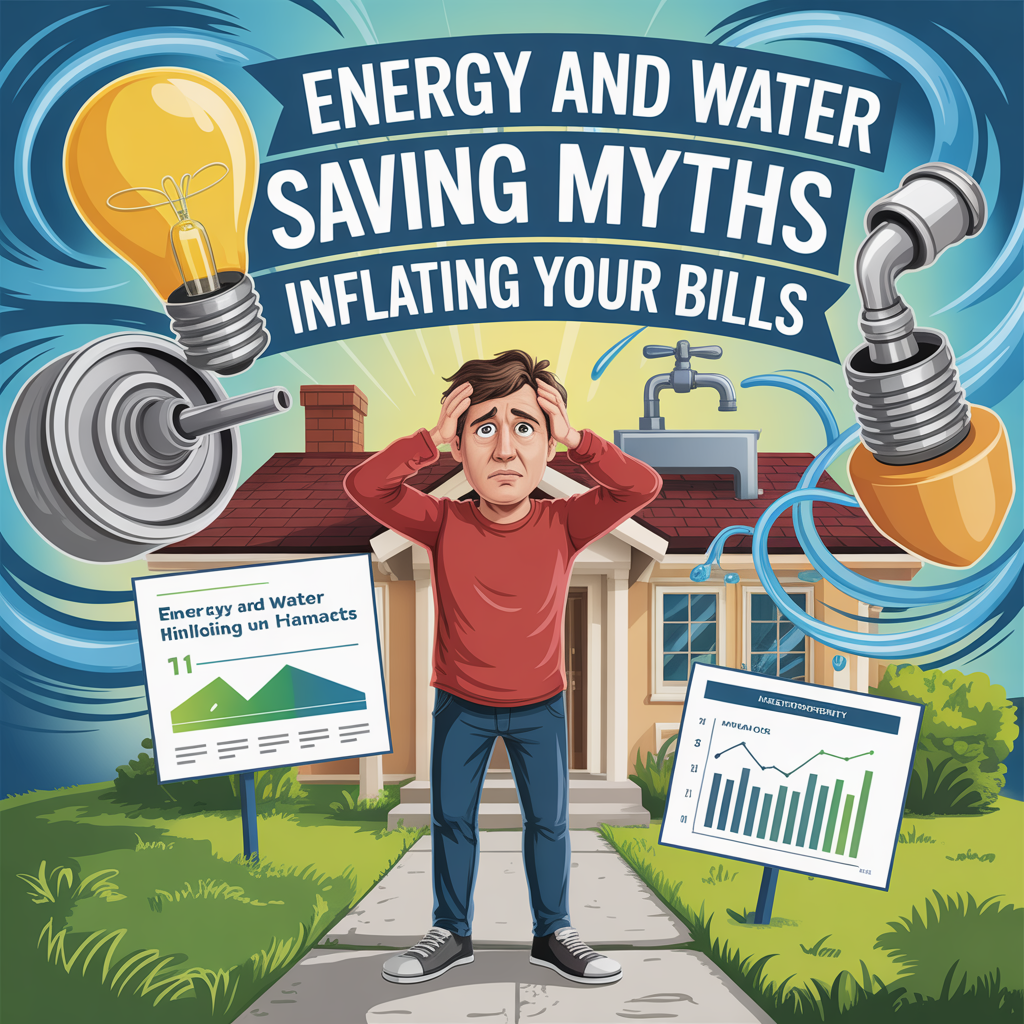
Are you following energy and water saving myths that don’t work, potentially inflating your utility bills when you’re actually trying to save? If you’re constantly looking for ways to reduce those climbing household expenses, you’re not alone, and my science-backed fixes are here to help you navigate the often confusing world of energy and water conservation advice.
Welcome to Part 3 of my “Home Science Debunked” series, where we use clear, simple science to separate fact from fiction, empowering you to make genuinely effective and economical choices for your home. This article tackles some of the most persistent energy and water saving myths that might be costing you more than you think.
As your practical and authoritative advisor for a smarter home, I’ll guide you through the real science behind common beliefs. We’ll investigate if constantly unplugging appliances truly slashes your electric bill or if it’s sometimes overkill. Is washing dishes by hand always more water-efficient than using a modern dishwasher?
And what about that age-old debate: does leaving lights on actually use less energy than turning them off and on frequently? I’m here to provide clear, evidence-based answers to these questions, helping you understand what really works.
Get ready to bust some myths and discover strategies that will genuinely lower your utility bills and reduce your environmental footprint without unnecessary effort. By the end of this guide, you’ll be equipped with factual knowledge to make informed decisions, cut through the noise of outdated advice, and truly optimize your home’s energy and water consumption. Let’s uncover the truth and start saving for real!
Energy Saving Myth #1: “Always Unplug Appliances to Slash Your Electric Bill!”
This is a big one you hear all the time: “Always unplug your appliances when you’re not using them to slash your electric bill!” The idea is that many devices secretly suck power even when they’re “off,” contributing to a higher bill. While there’s a kernel of truth here, as your practical advisor, I’m here to tell you that the impact of this practice is often overstated, and sometimes the effort might outweigh the actual savings. Let’s look at the science and find a smarter approach to tackling these so-called “energy vampires” – a key step in debunking energy and water saving myths.
The Claim vs. The Facts: Understanding Vampire Power
The “kernel of truth” in this myth lies in what’s known as standby power or vampire power. Many modern electronics and appliances do indeed continue to draw a small amount of electricity even when they are turned off but still plugged in. This power is used for things like:
- Maintaining clock displays (microwaves, coffee makers).
- Keeping remote control sensors active (TVs, game consoles).
- Powering internal memory or settings.
- Keeping devices ready for instant-on functionality.
The claim is that this collective standby power from all your devices adds up to a significant drain on your electricity bill. While this was more of an issue with older, less efficient electronics, the facts are that modern appliances, especially those with Energy Star ratings, have become much better at minimizing standby power consumption.
According to the U.S. Department of Energy, vampire power can account for about 5% to 10% of residential electricity use. While not insignificant, it’s not always the bill-busting culprit it’s made out to be for every appliance.
The Real Deal: When Unplugging Matters (and When It’s Overkill)
So, when does the effort of unplugging actually translate into noticeable savings, and when is it just an unnecessary hassle?
- Where Unplugging Can Matter:
- Older Electronics: Devices manufactured a decade ago or more tend to be less efficient in standby mode. If you have an old VCR, stereo system, or a non-smart TV still plugged in, they might be silent energy consumers.
- Chargers (Even Without a Device Attached): Many phone, laptop, and tablet chargers (especially older or cheaper ones) can draw a small amount of power even when no device is connected. While the individual draw is tiny, multiple chargers can add up.
- Devices with “Instant-On” Features or Constant Connectivity: Some game consoles, set-top boxes, or smart speakers that are always listening or ready to update might have a higher standby draw.
- Where Unplugging is Often Overkill (Minimal Savings):
- Modern, Energy-Efficient Appliances: Most new refrigerators, washing machines, ovens, and microwaves have very low standby power consumption. The effort of constantly unplugging and replugging these might save you mere pennies over a year.
- Small, Simple Devices: Things like a digital alarm clock or a simple coffee maker (without a constant hot plate) draw negligible power in standby.
The “real deal” is that selectively unplugging can save some money, but it’s not the magic bullet for drastically slashing your entire electric bill for most households today.
Smarter Solution: Identify True Energy Hogs & Use Power Strips
Instead of obsessively unplugging everything, here’s a more practical and efficient approach:
- Identify Your “True Energy Hogs”:
- Focus on clusters of electronics like your home entertainment center (TV, game console, sound system, streaming devices) or your home office setup (computer, monitor, printer, chargers). These are often where multiple devices contribute to standby power.
- Consider appliances that are older or known for higher standby use. You can sometimes find this information online or even purchase a simple electricity usage monitor to test individual devices if you’re really curious. (MenteMestra: This could be a good place for an internal link to a future article about “How to Conduct a Home Energy Audit” or “Tools to Measure Appliance Energy Use” if such articles are planned within the “Laboratório Doméstico” silo).
- Utilize Smart Power Strips:
- This is my top “insider” tip! Plug groups of related devices (like your TV setup or computer peripherals) into a power strip with an on/off switch. Then, you can turn off all those devices with a single flick of the switch when they’re not in use (e.g., before bed or when leaving the house for an extended period).
- There are even “smart” power strips that can detect when a primary device (like a TV or computer) is turned off and then automatically cut power to connected peripheral devices.
- Prioritize Bigger Energy Savers: While managing vampire power is good, remember that larger energy savings often come from upgrading to more energy-efficient main appliances (fridge, HVAC, water heater), improving home insulation, and being mindful of thermostat settings. Unplugging your phone charger will save far less than upgrading an ancient, energy-guzzling refrigerator.
By being strategic rather than obsessive about unplugging, you can achieve meaningful savings without unnecessary daily inconvenience.
Water Saving Myth #2: “Washing Dishes by Hand Always Uses Less Water Than a Dishwasher!”
This is a deeply ingrained belief for many households, often passed down through generations: the myth that washing dishes by hand is inherently more water-efficient than using an automatic dishwasher. The image of a running tap during handwashing versus the contained cycle of a dishwasher makes it seem counterintuitive that a machine could be more frugal with water.
However, as your science-minded advisor, I’m here to reveal that for most modern homes, this is one of those energy and water saving myths that needs a serious update, especially if you’re looking to reduce your utility bills.
The Claim vs. The Facts: Modern Dishwasher Efficiency
The claim is straightforward: you control the water flow when washing by hand, so surely you use less. The facts, however, paint a different picture, largely due to significant advancements in dishwasher technology:
- Outdated Comparisons: The myth likely stems from experiences with older dishwashers (from the 1990s or earlier), which were often water guzzlers.
- Modern Marvels: Today’s dishwashers, especially Energy Star certified models, are designed with water and energy efficiency as top priorities. An Energy Star dishwasher can use as little as 3 to 5 gallons (about 11 to 19 liters) of water per cycle. Some ultra-efficient models use even less.
- The Handwashing Reality: Studies have shown that the average person washing dishes by hand with the tap running (even intermittently) can use significantly more water – often up to 20-27 gallons (about 75-102 liters) of water for the same amount of dishes! Even a more conservative handwasher using a “two-basin” method (one for washing, one for rinsing) typically uses more water than an efficient, fully loaded dishwasher.
The science behind this is linked to how dishwashers work: they recycle a relatively small amount of heated water, spraying it at high pressure to clean dishes effectively. Handwashing often relies on a continuous flow or multiple basin fills of fresh water.
The Real Deal: How a Fully Loaded Dishwasher Can Be a Water Saver
The key phrase here is “fully loaded.” A dishwasher achieves its peak water and energy efficiency when it’s run with a full load of dishes.
- Efficiency in Volume: Washing a few items in a mostly empty dishwasher is wasteful. But when you compare a full load in an efficient machine to washing that same large quantity of dishes by hand, the machine almost always wins on water usage.
- Energy Considerations Too: Dishwashers also heat the water internally to very high temperatures (often hotter than you’d tolerate for handwashing), which aids in sanitizing and breaking down grease. Modern machines do this efficiently. Handwashing often involves letting the hot water tap run, which uses your home’s water heater – a major energy consumer.
So, the “real deal” is that if you have an Energy Star certified dishwasher and you run it only when it’s full, you are very likely saving a significant amount of water (and potentially energy for water heating) compared to washing those same dishes by hand.
Smarter Solution: Maximize Dishwasher Loads & Scrape, Don’t Rinse (Usually!)
To truly leverage your dishwasher as a water and money-saving tool:
- Always Run Full Loads: This is the golden rule. Wait until the dishwasher is completely full before starting a cycle.
- Scrape, Don’t Pre-Rinse (for most modern dishwashers): This is another major myth buster! Most modern dishwashers are powerful enough to handle food particles without extensive pre-rinsing. Simply scrape off large food scraps into the trash or compost bin. Pre-rinsing dishes under a running tap before loading them into the dishwasher can waste gallons of water unnecessarily and essentially negates the machine’s water-saving benefits. Your dishwasher detergent is designed to cling to food particles; if you rinse them all off, the detergent has less to work on! (MenteMestra: This could link to a future article in the “Cozinha Inteligente” silo about “Maximizing Your Dishwasher’s Efficiency and Lifespan”).
- Choose the Right Cycle: Use shorter or “eco” cycles when appropriate for lightly soiled dishes. Avoid “heat dry” settings if you want to save more energy; simply open the dishwasher door after the final rinse to let dishes air dry.
- Maintain Your Machine: Clean the dishwasher filter regularly as per the manufacturer’s instructions to ensure it continues to run efficiently.
By understanding the true efficiency of modern dishwashers and using them correctly, you can confidently bust this common myth and turn your machine into an ally for both water conservation and lower utility bills.
Energy Saving Myth #3: “Leaving Lights On Uses Less Energy Than Turning Them Off and On!”
This is a classic piece of advice that many of us heard growing up, especially in relation to fluorescent lights: the myth that it takes more energy to turn a light off and then on again than it does to just leave it burning if you’re only leaving the room for a short time.
While this might have had a sliver of truth for very specific, older lighting technologies, for the vast majority of lights in our homes today, this is one of those energy and water saving myths that definitely needs to be switched off.
The Claim vs. The Facts: Incandescent vs. LED/CFL Bulbs
The origin of this myth is often tied to older fluorescent tube lighting (the long tubes common in offices or garages, or older compact fluorescent lamps – CFLs).
- Older Fluorescents: These lights did have a slightly higher “inrush current” (a brief surge of power) when first turned on, and frequent switching could theoretically shorten their lifespan somewhat. However, even for these, the extra energy used at startup was typically equivalent to only a few seconds of normal operation.
- Incandescent Bulbs: These traditional, inefficient bulbs use the same amount of energy whether they’re being turned on or are already on. There’s no energy penalty for switching them on and off.
- Modern LEDs and CFLs:
- LEDs (Light Emitting Diodes): These are the energy-efficiency champions. They use very little energy to begin with, have virtually no significant inrush current, and their lifespan is not negatively affected by frequent switching.
- CFLs (Compact Fluorescent Lamps): While they do have a small inrush current, it’s minimal, and the energy saved by turning them off for even a few minutes far outweighs the startup energy. Their lifespan can be slightly reduced by very frequent on/off cycles (e.g., every few seconds), but for normal room usage, this is not a major concern.
The Real Deal: The (Tiny) Inrush Current Myth
For the types of lighting most commonly used in homes today (especially LEDs and modern CFLs), the idea that the startup energy surge is significant enough to warrant leaving them on is largely a myth.
- Negligible Extra Energy: The extra electricity consumed during startup for an LED or CFL is minuscule, typically lasting for a fraction of a second. It’s equivalent to just a few seconds (at most) of the light being on.
- Energy Waste of Leaving Lights On: If you leave a room for more than a minute or two, you will almost always save energy by turning the light off, regardless of the bulb type (with the possible exception of very specialized industrial lighting, which isn’t relevant for homes).
The “real deal” is that you save energy by turning lights off when they are not needed.
Smarter Solution: Turn Off Lights When You Leave a Room (Especially Modern Bulbs!)
The most practical and energy-efficient advice is refreshingly simple:
- If you’re leaving a room, even for just a few minutes, turn off the lights. This is especially true for energy-efficient LEDs and CFLs, but it’s a good habit for all lighting types.
- Utilize Natural Light: During the day, make the most of natural light by opening blinds and curtains. This is the ultimate free and energy-efficient light source!
- Consider Occupancy Sensors or Timers: For areas where lights are frequently left on accidentally (like bathrooms, closets, or kids’ rooms), installing inexpensive occupancy sensors (that turn lights on when they detect motion and off after a period of inactivity) or timers can be a smart, energy-saving investment. (MenteMestra: This could link to a future article in the “Autossuficiência Urbana Criativa” silo about “Simple DIY Home Automation for Energy Savings”).
- Upgrade to LEDs: If you haven’t already, gradually replace your old incandescent bulbs with LEDs. They use up to 75-80% less energy and last much, much longer, offering significant long-term savings on both your electricity bill and bulb replacement costs.
So, feel free to flick that switch! Busting this myth means you can confidently turn off lights to save energy and money without worrying about any supposed “startup penalty.”
Your Path to Smaller Bills: Real Strategies for Energy and Water Conservation
We’ve journeyed through some of the most common energy and water saving myths, armed with simple science to illuminate the truth. From understanding the real impact of “vampire power” and the surprising efficiency of modern dishwashers, to knowing when to flick that light switch off without a second thought, my goal as your practical and authoritative advisor has been to empower you. By debunking these misconceptions, you’re now equipped to stop accidentally wasting resources and, more importantly, to stop overpaying on your utility bills.
The path to smaller bills and a more efficient home isn’t about adopting every extreme “hack” you hear; it’s about understanding the fundamental principles and applying real, science-backed strategies.
- Be Mindful, Not Obsessive: Focus on impactful changes. Selectively unplugging clusters of electronics with a power strip is smart; unplugging your microwave clock daily is likely not worth the effort for the minuscule savings.
- Embrace Modern Efficiency: Trust that many modern appliances (especially Energy Star rated ones) are designed to be efficient. Use them as intended (e.g., full dishwasher loads, cold water laundry when appropriate).
- Simple Habits, Big Impact: Turning off lights, fixing leaky faucets (a huge water waster!), taking shorter showers, and being conscious of your thermostat settings often yield far greater savings than many overhyped myths.
This is just the beginning of our “Home Science Debunked” journey. By continuing to question, learn, and apply a little bit of everyday science to your household routines, you can transform your home into a model of efficiency and economy. You have the power to make informed choices that benefit both your wallet and the planet.
FAQ: Your Top Energy & Water Saving Myth Questions Answered
Here are some quick answers to other common questions that arise when debunking energy and water saving myths:
1. Does putting a brick or bottle in my toilet tank really save water?
Yes, this old trick can save a small amount of water per flush by displacing some of the water in the tank, meaning less water is used to fill it. However, ensure the object doesn’t interfere with the flushing mechanism. Modern low-flow toilets are already very efficient, so this might have a more noticeable impact on older, less efficient toilets.
2. Is it true that screensavers save energy on computers?
This is largely a myth for modern monitors. Screensavers were originally designed to prevent “burn-in” on older CRT monitors. For modern LCD or LED monitors, a screensaver (especially one with a lot of movement or graphics) can actually use more energy than simply letting the monitor go into its low-power sleep mode. The best energy-saving practice is to set your computer and monitor to go to sleep after a short period of inactivity.
3. Will charging my phone overnight damage the battery or waste a lot of energy?
Modern smartphones and their chargers are quite “smart.” They typically stop drawing significant power once the battery is fully charged, or reduce it to a trickle. So, while leaving it plugged in all night does consume a tiny bit more energy than unplugging it, the amount is usually very small and unlikely to significantly impact your bill or drastically shorten your battery’s overall lifespan with modern battery management systems. The bigger “vampire” culprits are often older chargers or devices.
4. If I have an electric water heater, should I turn it off when I go on vacation?
For short trips (a few days), the energy savings from turning off an electric water heater are often minimal and might not be worth the hassle, as it will need to reheat all the water when you return. For longer vacations (a week or more), turning it down to a “vacation” setting (if it has one) or turning it off at the circuit breaker can save energy. However, always consult your water heater’s manual, and be aware of any potential issues with turning it off in very cold climates (risk of freezing pipes if the home’s heat is also very low).
5. What’s one overlooked area where I might be wasting significant energy or water without realizing it?
One often-overlooked culprit is leaky faucets or running toilets. A slowly dripping hot water faucet can waste a surprising amount of heated water (and energy!) over time. A toilet that runs continuously (even silently) can waste hundreds of gallons of water a day. Regularly checking for and fixing these small leaks can lead to very real savings on both your water and energy bills (if it’s a hot water leak).

C. Holmes is the keen analytical mind behind Infinitas Minds, a blog dedicated to revolutionizing the way we approach home economics. With a meticulous eye for detail and a passion for logical solutions, C. Holmes tackles everyday challenges to reveal hidden opportunities for efficiency and savings. His mission is to simplify life, spark innovation, and offer practical, insightful approaches for navigating our often-complex world with greater ease and financial clarity.
Driven by a belief that true mastery of home economics lies in understanding the ‘why’ and ‘how’ behind every decision, C. Holmes curates comprehensive guides, actionable experiments, and groundbreaking perspectives. Expect a blend of sharp analysis, creative problem-solving, and a touch of ingenuity in every piece, empowering readers to transform their homes into havens of efficiency and peace.