
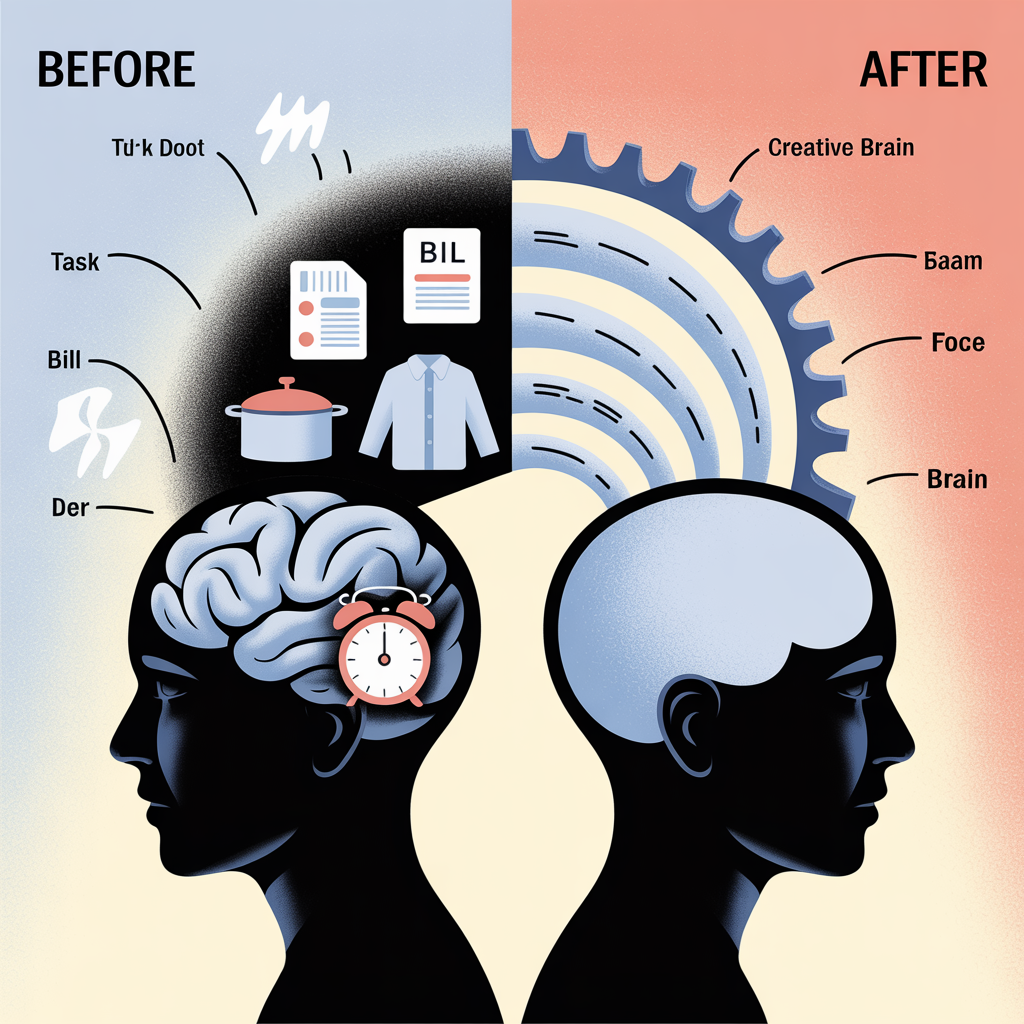
It’s 7 PM on a Tuesday. After a long day of work filled with hundreds of micro-decisions—which email to answer first, what feedback to give in a meeting, how to navigate the São Paulo traffic—you walk into your apartment. You open the refrigerator, stare blankly at its contents, and the seemingly simple question, “What’s for dinner?”, feels like an insurmountable intellectual challenge.
Defeated, you close the door, pick up your phone, and order takeout for the third time this week. You don’t do it because you necessarily want to, but because it is the path of least resistance. It is the easiest decision.
If this scene strikes a chord, you are not failing at “adulting.” You are experiencing a well-documented psychological phenomenon known as decision fatigue. It’s the quiet culprit behind much of our daily stress, procrastination, and poor choices. And in the decision-rich environment of modern urban life, it’s a constant battle.
This guide is your manual for fighting back. We will explore the fascinating science of why your brain gets “tired” from making choices, and then we will build a renter-friendly framework for automating household tasks. This is not about expensive smart-home gadgets; it’s about creating simple, elegant systems to put recurring domestic decisions on autopilot, thereby preserving your most precious and finite resource: your mental energy. Welcome to the next level of The Intentional Home.
The Science of Willpower: Why Your Brain Gets “Tired”
To solve a problem, we must first understand it. Decision fatigue isn’t a feeling; it’s a measurable depletion of your cognitive resources.
Understanding Ego Depletion: Your Willpower as a Muscle
Groundbreaking research by psychologist Roy Baumeister introduced the concept of “ego depletion.” The theory posits that our capacity for self-control and rational decision-making is a finite resource, much like a muscle. Every single decision you make throughout the day, no matter how small, flexes this muscle and uses up a bit of its energy.
- Should I hit snooze? (Decision 1)
- What should I wear? (Decisions 2-5)
- Which route should I take to work? (Decision 6)
- How should I word this email? (Decisions 7-20) By the time you get home, your “willpower muscle” is exhausted.
The Consequence: Decision Avoidance and Poor Choices
When your cognitive resources are depleted, your brain enters a state of self-preservation. It begins to look for shortcuts. This manifests in two ways:
- Reckless Decision-Making: You become more impulsive. You buy the thing you don’t need, you eat the junk food, you say the thing you later regret.
- Decision Avoidance: This is the most common outcome for household management. Faced with another set of choices (what to cook, what to clean), the tired brain simply opts out. It chooses the ultimate easy answer: nothing. This is why clutter piles up and takeout menus become so appealing. It’s not laziness; it’s a cognitive shutdown.
Why Renters Are Especially Vulnerable
The urban renter’s life is often dense with low-level decisions that homeowners may not face. Navigating building rules, dealing with shared laundry facilities, managing smaller spaces that require more frequent tidying, and making daily commute calculations all contribute to a higher baseline of decision fatigue before the “home” tasks even begin.
The Automation Manifesto: Your Strategy for a Simpler Life
Automation is the strategic antidote to decision fatigue. It is the act of making a decision once, and then creating a system that executes that decision automatically in the future.
- Principle #1: The Power of the “Uniform”. Successful people from Steve Jobs to Barack Obama famously wore a limited rotation of outfits to eliminate a daily decision. We can apply this “uniform” concept to all areas of our lives: a uniform for weekday breakfasts, a uniform for cleaning routines, a uniform for how you pack your work bag.
- Principle #2: Batching Similar Tasks. Switching between different types of tasks (e.g., paying a bill, then writing an email, then washing dishes) requires a significant mental “gear-shift.” Batching involves grouping all similar tasks together—pay all your bills on the 1st of the month, run all your errands on Saturday morning. This reduces the cognitive cost of task-switching.
- Principle #3: The Two-Minute Rule. Popularized by productivity expert David Allen, this rule is simple: If a task takes less than two minutes to complete, do it immediately. Putting away your keys, rinsing your plate, wiping a small spill—doing these things instantly prevents them from becoming “open loops” that occupy mental space and later require a decision to address.
Renter-Friendly Automation Systems in Action
Here is how to apply these principles to your apartment life without any permanent changes.
Automating Your Food Life
- The Themed Meal Plan: This is the ultimate weapon against the “What’s for dinner?” question. Assign a theme to each night of the work week. This provides structure while still allowing for flexibility.
- Example: Monday = Massa (Pasta), Tuesday = Salada Completa (Big Salad), Wednesday = Ovos (Eggs/Omelets), Thursday = Restos (Leftovers), Friday = Pizza or Lanche (Pizza or Sandwich night).
- Now, the question isn’t “What should I eat?”; it’s “What kind of pasta should I make?”. The decision is smaller, simpler, and less draining.
- The “Auto-Replenish” Grocery List: Keep a magnetic notepad or a shared digital note on the fridge. The household rule is simple: when you use the last of a staple item (rice, olive oil, coffee, toilet paper), it is immediately written on the list. This completely automates the creation of your shopping list and ends the “Do we have…?” scavenger hunts.
Automating Your Wardrobe
- The “Weekly Uniform” Rack: On Sunday, as part of your Sunday Reset Routine, check the weather for the week ahead and pull five complete outfits (including accessories). Hang them together in one section of your closet. Each morning, your only decision is to grab the next outfit in line. This can save you 10-15 minutes and dozens of micro-decisions every single morning.
- The “One In, One Out” Rule: For renters in small apartments, closet space is precious. Automate decluttering with this simple rule. Before you are allowed to put a newly purchased item of clothing into your closet, you must select a similar old item to donate or discard. This prevents accumulation and the future overwhelming task of a massive closet purge.
Automating Your Cleaning Routine
- The “Closing Shift” Habit: Frame the 15-Minute Tidy from our previous guide as a non-negotiable end-of-day routine. Just as a café has a “closing shift,” so should your kitchen. Before you go to bed, set a timer for 15 minutes and reset the kitchen to a neutral state: load the dishwasher, wipe the counters, put things away.
- Habit Stacking: This is a powerful technique for building new habits. Link a new, desired habit to an existing, automatic one.
- “After I brew my morning coffee, I will immediately wipe down the kitchen counters.”
- “While the microwave is running, I will empty the compost bin.”
- “After I take off my work shoes, I will immediately put them in the closet.”
Automating Your Finances (Renter Edition)
- Débito Automático is Your Best Friend: In Brazil, this is incredibly easy to set up. Put every recurring bill you can—rent (aluguel), condo fees (condomínio), internet, electricity (conta de luz), cell phone—on automatic payment. This eliminates monthly due-date anxiety and the decision of “when should I pay this?”.
Frequently Asked Questions (FAQ)
- This sounds very rigid and boring. Won’t automating everything remove all spontaneity from my life?
- It’s actually the opposite. By automating the boring, repetitive, low-value decisions (what to wear to work, what to eat on a Tuesday), you are liberating your mental energy and willpower for more important, spontaneous, and creative things. You’ll have more brainpower left for your hobbies, your relationships, and deciding on a fantastic new restaurant to try on the weekend.
- I share my apartment with a roommate who is not this organized. How can I implement these systems?
- Focus entirely on your own domain. You can automate your wardrobe, your portion of the bills, and your cleaning habits. For shared spaces like the kitchen, lead by example. When your roommate sees that your “closing shift” habit means the kitchen is always clean in the morning, they may be inspired. You can also agree on one or two simple shared systems, like the “Auto-Replenish” grocery list for communal items.
- What is the one, single decision I can automate today that will have the biggest impact?
- Without a doubt: preparing your “launch pad” the night before. This means setting out your clothes for the next day, packing your bag, and preparing your coffee maker. This automates your first 5-10 decisions of the day, setting a calm, proactive tone for everything that follows.
- I feel like I’m just too busy to set up these systems. Isn’t this just adding another big task to my to-do list?
- There is a small upfront investment of time and energy, but the payoff is enormous. Invest one hour on a Sunday to create a themed meal plan, and you buy back hours of stress and indecision during the week. The goal is to be a strategic investor of your own time and energy.
- Does decision fatigue affect our spending habits?
- Absolutely. It’s one of the primary drivers of impulse purchases. At the end of a long day, when your willpower is low, you are far more likely to add unnecessary items to your online shopping cart or buy the expensive, convenient pre-packaged meal at the grocery store. By reducing your overall decision load, you’ll find you have more mental energy to make conscious, budget-friendly spending choices.
Freeing Your Mind for What Truly Matters
The goal of automating your household is not to turn you into a robot, but to free you from the tyranny of the mundane. Each repetitive decision you eliminate is a small liberation of your cognitive resources. Every system you build is a gift of time and energy to your future self. By intentionally designing a life that runs more smoothly on autopilot, you are not losing spontaneity; you are creating more space for it. You are conserving your best thinking, your deepest creativity, and your most patient energy for the people and passions that truly define your life. That is the ultimate purpose of The Intentional Home.

C. Holmes is the keen analytical mind behind Infinitas Minds, a blog dedicated to revolutionizing the way we approach home economics. With a meticulous eye for detail and a passion for logical solutions, C. Holmes tackles everyday challenges to reveal hidden opportunities for efficiency and savings. His mission is to simplify life, spark innovation, and offer practical, insightful approaches for navigating our often-complex world with greater ease and financial clarity.
Driven by a belief that true mastery of home economics lies in understanding the ‘why’ and ‘how’ behind every decision, C. Holmes curates comprehensive guides, actionable experiments, and groundbreaking perspectives. Expect a blend of sharp analysis, creative problem-solving, and a touch of ingenuity in every piece, empowering readers to transform their homes into havens of efficiency and peace.