
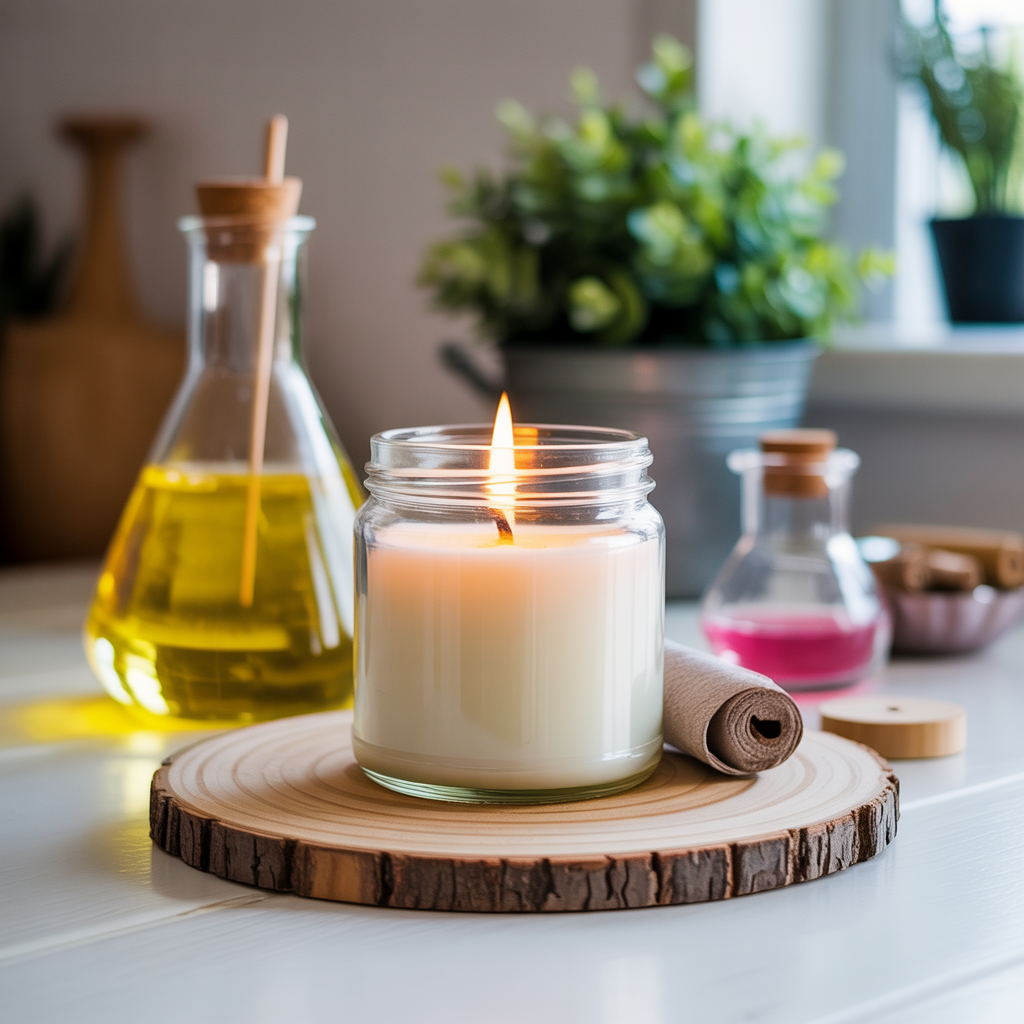
There’s a unique, primal comfort in the flickering flame of a candle. It creates an instant atmosphere of calm, coziness, and intimacy. But the world of commercial candles can be opaque, often filled with petroleum-based waxes, mystery fragrances, and high price tags. What if you could move from being a consumer to a creator?
What if you could design your own signature scents and craft beautiful, eco-friendly candles with your own hands? This isn’t just a craft project; it’s a fascinating entry into applied chemistry, and it’s the subject of today’s guided experiment in the Home Lab.
This is more than just a simple recipe. This is my ultimate DIY candles making guide, designed for the curious beginner who wants to do things the right way. We will explore the science behind each component—the wax, the wick, and the scent—to understand not just how to make a candle, but why certain materials behave the way they do.
We’ll establish an unskippable safety protocol, walk through a detailed tutorial on how to make soy candles, and finish with a robust troubleshooting guide for common problems.
By the end of this dossier, you will have the knowledge and confidence to create high-quality, long-lasting candles that are safer for your home and better for the planet. Prepare to light more than just a wick; you’re about to spark a new passion.
The Anatomy of a Candle: A Trio of Science
Candles appears simple, but it’s a perfectly balanced system of three scientific principles working in harmony. Understanding them is the key to success.
The Fuel Source: Choosing Your Wax
The wax is the body and soul of your candles; it is the fuel that the flame consumes. The type of wax you choose will determine your candle’s burn time, scent performance, and environmental impact.
- Paraffin Wax: The most common wax in commercial candles, paraffin is a byproduct of petroleum refining. It’s inexpensive and has an excellent scent throw (how well it releases fragrance). However, it’s derived from a non-renewable resource and can release toxins when burned. We will be avoiding it in our eco-friendly project.
- Natural Waxes: This is where our focus lies. These are waxes derived from renewable, natural sources.
- Soy Wax: Made from hydrogenated soybean oil, soy wax is the gold standard for beginner DIY candle makers. It’s affordable, burns cleanly and slowly, and is easy to clean up with just soap and water. Its main drawback is a more subtle scent throw compared to paraffin.
- Beeswax: A beautiful, natural wax produced by honeybees. It has a naturally sweet, honey-like scent and is said to have air-purifying properties. It burns very slowly but is more expensive and can be tricky to scent, as its natural aroma can compete with added fragrances.
- Coconut Wax: Made from hydrogenated coconut oil, often blended with other natural waxes. It has a fantastic scent throw, a creamy white appearance, and a clean burn. It’s a more luxurious, and therefore more expensive, option.
Wax Comparison Matrix
| Feature | Soy Wax | Beeswax | Coconut Wax |
| Source | Soybeans | Bees | Coconuts |
| Eco-Friendly | High | High | High |
| Scent Throw | Moderate | Low (has own scent) | Excellent |
| Burn Time | Long | Very Long | Long |
| Cost | Low | High | High |
| Ease of Use | Excellent for beginners | Moderate | Good |
Exportar para as Planilhas
For our main experiment, we will be using soy wax for its accessibility, ease of use, and eco-friendly properties.
The Pathway: Understanding Wicks and Capillary Action
The wick is not just a string; it’s the engine of the candle. It works through a scientific principle called capillary action. When you light the wick, the heat from the flame melts the wax directly beneath it into a liquid pool. The wick, made of absorbent fibers, then draws the liquid wax upwards, against gravity.
This liquid wax is then vaporized by the heat of the flame, and it is this wax vapor—not the solid wick—that actually burns.
The most critical factor here is sizing your wick. A wick that is too small for the container will create a “tunnel,” leaving a thick wall of unused wax. A wick that is too large will create an dangerously large flame, excessive smoke, and will burn through the candle too quickly. Always check your wax or wick supplier’s recommendations for the correct wick size based on the diameter of your container.
The Soul: The Art & Science of Scent
Scent is what transforms a candle from a light source into an experience. You have two main choices for adding fragrance:
- Essential Oils (EOs): These are natural oils extracted directly from plants. They offer true-to-nature scents and potential aromatherapeutic benefits. However, they are highly volatile, can have low flash points (the temperature at which they can ignite), and their scent does not always perform well in hot wax. They are best for a very subtle, natural aroma.
- Fragrance Oils (FOs): These are synthetic oils specifically engineered for use in candles. They are formulated to be stable at high temperatures and to bind well with wax molecules, resulting in a much stronger and more reliable scent throw. For a powerful, room-filling scent, fragrance oils are the superior choice.
When adding any scent, you must respect its flash point and the wax’s ideal binding temperature. Adding fragrance oil to wax that is too hot can cause the delicate top notes of the scent to burn off. Adding it to wax that is too cool will prevent it from binding properly, resulting in a weak scent and oil seeping out of the finished candle.
Your Home Candle Laboratory: Essential Equipment & Safety Protocol
Preparation and safety are non-negotiable in this experiment.
The Must-Have Equipment List
- Heat Source: A stovetop or a dedicated hot plate.
- Double Boiler: A pouring pot for the wax placed inside a larger saucepan filled with water. This ensures gentle, indirect heat. Never melt wax directly on a flame.
- Kitchen Scale: For accurately measuring your wax and fragrance oil.
- Candy or Digital Thermometer: Absolutely essential for monitoring wax temperature.
- Pouring Pot: A dedicated pot with a spout for melting and pouring wax.
- Containers: Heat-safe glass jars, tins, or ceramic vessels.
- Wicks & Wick Stickers/Hot Glue: To secure the wick to the bottom of the container.
- Wick Centering Tool: A clothespin, chopsticks, or a dedicated tool to hold the wick perfectly centered while the wax cools.
- Paper Towels & Rubbing Alcohol: For easy cleanup.
The Unskippable Safety Protocol
- NEVER leave melting wax unattended, even for a moment. Wax is a flammable oil.
- Work in a well-ventilated area on a protected, level surface.
- Keep a fire extinguisher rated for grease fires nearby. DO NOT use water to extinguish a wax fire; it will cause the burning wax to splatter.
- Wear safety glasses and an apron. Hot wax can splash and cause severe burns.
- Keep children and pets away from the work area.
The Main Experiment: Crafting Your First Soy Wax Container Candle
This step-by-step guide will walk you through the process from start to finish.
- Preparation and Measurement: Clean your candle container thoroughly with soap and water, then wipe it with rubbing alcohol to ensure it is free of any residue. Use your scale to measure the amount of soy wax flakes you need. A good rule of thumb is that the amount of solid wax flakes will be roughly double the volume of your container.
- Secure the Wick: Peel the backing off a wick sticker, press it to the metal base of your wick, and then press the wick firmly into the exact center of your container’s bottom.
- Melt the Wax: Set up your double boiler. Add the soy wax flakes to your pouring pot. Heat the water in the larger saucepan over medium heat. Monitor the wax with your thermometer as it melts, stirring gently.
- Monitor the Temperature: Heat the soy wax to its recommended melting temperature, typically around 185°F (85°C). This allows the wax crystals to fully break down. Once it reaches this temperature, turn off the heat.
- Add Fragrance: Let the wax cool to the specific temperature recommended by your fragrance oil supplier (usually around 140-160°F or 60-71°C). Add your pre-measured fragrance oil (a typical load is 6-10% of the wax weight) and stir gently but thoroughly for two full minutes. This step is crucial for ensuring the oil binds completely with the wax.
- Pour the Wax: Let the wax cool a little further, to about 135°F (57°C). Pour the scented wax into your container slowly and steadily to minimize air bubbles.
- Center and Secure the Wick: Immediately after pouring, use your clothespin or centering tool to hold the wick taut and perfectly in the center of the container.
- The Curing Process: Let the candle cool and solidify at room temperature, undisturbed, for at least 24 hours. This slow cooling process prevents cracks and frosting. After it’s solid, you must let it “cure.” Curing is the process where the wax and fragrance oil continue to bind and solidify, and it is essential for a good scent throw. For soy wax, a cure time of 1-2 weeks is recommended.
- Trim the Wick: Before you light your candle for the first time, trim the wick to about 1/4 inch.
Troubleshooting Common Candle Problems
- Problem: “Tunneling” – The candle burns straight down the middle, leaving a thick ring of unused wax.
- Cause & Solution: This is usually caused by a wick that’s too small for the container diameter or by not letting the candle burn long enough the first time. The first burn is critical: let the candle burn until the melted wax pool reaches the full edge of the container (about 1 hour for every inch of container diameter).
- Problem: “Frosting” – White, crystalline patterns appear on the surface or sides.
- Cause & Solution: This is a natural characteristic of soy wax and a sign that you are using 100% natural wax! It’s purely cosmetic. It can be minimized by controlling your pouring temperature and ensuring the candle cools slowly away from drafts.
- Problem: Weak Scent Throw
- Cause & Solution: This can have multiple causes: not adding enough fragrance oil (check the recommended percentage), adding the oil when the wax was too hot (burning it off), or not letting the candle cure for long enough (1-2 weeks is essential).
Frequently Asked Questions (FAQ)
- Can I reuse old candle jars from commercial candles?
- Absolutely! This is a fantastic way to be eco-friendly. To clean them, place the old jar in a pot of simmering water (like a double boiler) to melt the remaining wax, then pour the melted wax into the trash (not down the sink). Wash the jar thoroughly with hot, soapy water.
- Why do I need a thermometer? Can’t I just guess the temperature?
- No, a thermometer is the most critical tool for consistent results. The temperatures for melting the wax and adding the fragrance are precise. Guessing will lead to a weak scent throw, poor appearance (frosting/cracks), and wasted materials. It is an essential investment.
- Can I use crayons to color my candles?
- I strongly advise against it. Crayons are made with pigment, not dye, and the pigment particles are too large. They will clog your wick and create a fire hazard. Only use liquid or block dyes specifically designed for candle making.
- What is “curing” and why is it really so important?
- Curing is the crystallization process of the wax after it has solidified. During this time (1-2 weeks for soy), the fragrance oil becomes more evenly distributed and locked within the wax’s molecular structure. Lighting a candle before it’s fully cured is like drinking wine that hasn’t aged; the full scent profile has not yet developed.
- Are wood wicks better than cotton wicks?
- They are different, not necessarily better. Wood wicks can provide a lovely, gentle crackling sound, but they can be trickier for beginners to work with. They require precise sizing and sometimes need to be trimmed differently. I recommend mastering cotton wicks first before moving on to the experiment of wood wicks.
Lighting More Than Just a Wick
You have now completed your first journey into the art and science of candle making. You’ve learned to manipulate waxes, respect temperatures, and understand the intricate dance between fuel, flame, and fragrance. The candle sitting before you is more than just a source of light; it is a testament to your patience, your precision, and your desire to create something with your own hands. It is a tangible piece of the Home Lab ethos: taking everyday objects, deconstructing them to understand their principles, and recreating them in a way that is smarter, safer, and more satisfying. Light it with pride, knowing you’ve crafted not just an object, but a small moment of peace and beauty.

C. Holmes is the keen analytical mind behind Infinitas Minds, a blog dedicated to revolutionizing the way we approach home economics. With a meticulous eye for detail and a passion for logical solutions, C. Holmes tackles everyday challenges to reveal hidden opportunities for efficiency and savings. His mission is to simplify life, spark innovation, and offer practical, insightful approaches for navigating our often-complex world with greater ease and financial clarity.
Driven by a belief that true mastery of home economics lies in understanding the ‘why’ and ‘how’ behind every decision, C. Holmes curates comprehensive guides, actionable experiments, and groundbreaking perspectives. Expect a blend of sharp analysis, creative problem-solving, and a touch of ingenuity in every piece, empowering readers to transform their homes into havens of efficiency and peace.