
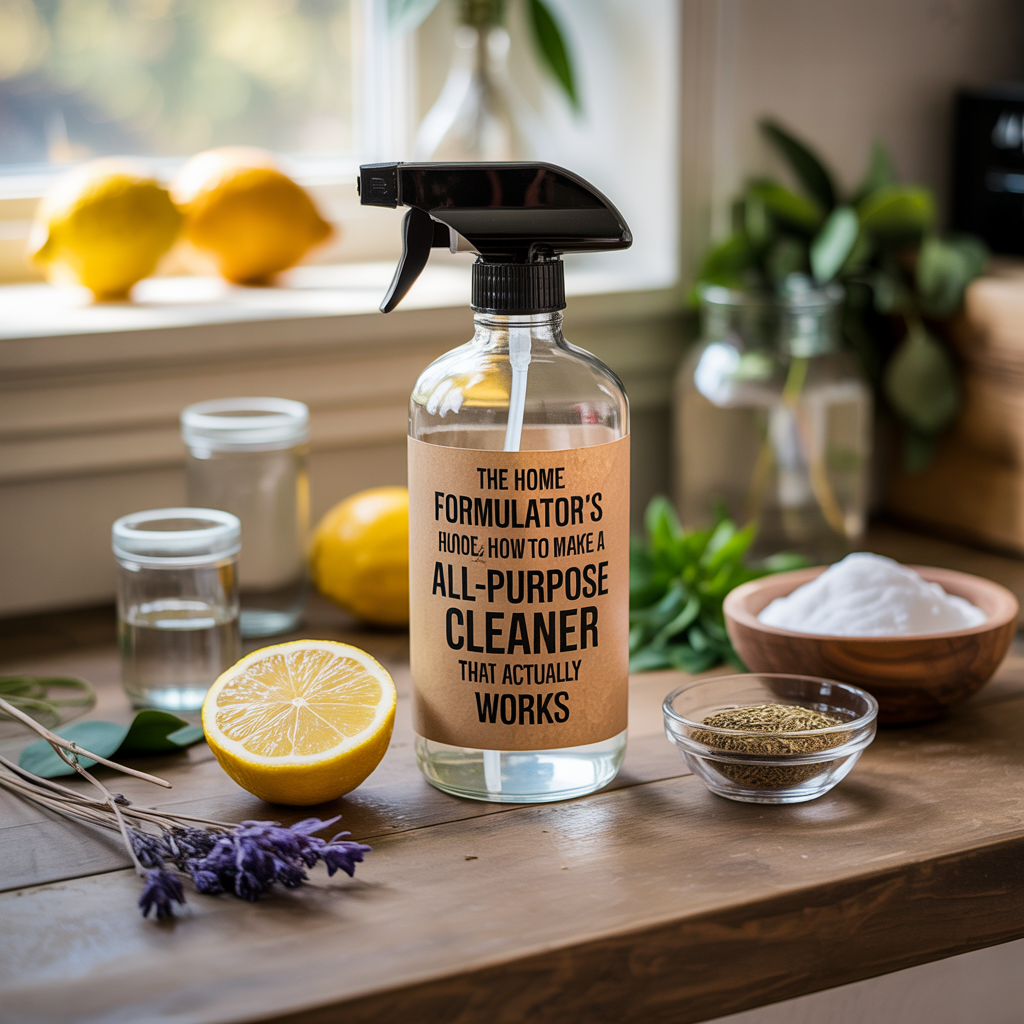
The cleaning aisle of any supermarket presents a dizzying array of choices, all promising a sparkling, germ-free home. The star of this show is the “All-Purpose Cleaner” (APC), a seemingly magical elixir in a spray bottle designed to tackle any mess. Yet, these commercial products often come with a high price tag, a long list of unpronounceable chemicals, and harsh synthetic fragrances.
In response, many of us have turned to DIY solutions, only to find that a simple mix of vinegar and water doesn’t quite cut through real-world grime. The internet is awash with recipes, many of which are ineffective or, worse, chemically unsound.
Today, we move beyond simply following recipes. Welcome to your advanced course in home formulation. This guide will not just give you a recipe for a DIY all-purpose cleaner; it will teach you the science behind creating one.
We will deconstruct the anatomy of an effective cleaner, exploring the essential roles of solvents, surfactants, and disinfecting agents. You will learn not just what to mix, but why you’re mixing it, how to customize formulas for specific jobs, and the critical safety protocols to follow.
Prepare to graduate from recipe follower to home formulator. By understanding these principles, you will be able to create a single bottle of cleaner that is more effective, safer, and significantly cheaper than almost anything you can buy at the store.
The Anatomy of an All-Purpose Cleaner: The Four Essential Roles
An effective APC isn’t just one ingredient; it’s a synergistic team where each component plays a critical role. To formulate your own, you must first understand the players.
The Solvent (The Base & Carrier)
The vast majority of your cleaner will be a solvent. Its primary job is to dissolve the other ingredients and carry them to the surface you’re cleaning.
- The Best Choice: Distilled Water. While tap water works, it contains minerals (especially here in cities like São Paulo) that can leave behind spots or streaks (limescale) and can also reduce the effectiveness of soaps. Distilled water is pure H2O, ensuring a streak-free finish and a more stable final product. It is the clean slate upon which we will build.
The Degreaser/Surfactant (The Muscle)
This is what gives your cleaner its real power against dirt and grease. Surfactants are miracle molecules with a unique structure: one end is attracted to water (hydrophilic) and the other is attracted to oil and grease (lipophilic). This allows them to grab onto grime, break it up, and lift it from the surface so the water can wash it away.
- Excellent Choices: Dr. Bronner’s Sal Suds or Castile Soap.
- Sal Suds: A plant-based surfactant, not technically a soap. It is ruthless on grease, creates minimal suds, and performs well in hard or soft water. It is my top recommendation for a powerful kitchen APC.
- Castile Soap: A true soap made from vegetable oils (like olive oil). It is gentler than Sal Suds and wonderfully versatile. Its main drawback is that it can react with hard water to leave behind a film and should never be mixed with acidic ingredients like vinegar (more on that later).
- A Cautious Choice: Dish Soap. While a great degreaser, many commercial dish soaps are designed to produce a lot of suds and can leave behind a residue that requires extra rinsing, making them less ideal for a spray-and-wipe cleaner.
The Disinfectant/Booster (The Power-Up)
It is critical to understand that “cleaning” (removing dirt) and “disinfecting” (killing pathogens) are two different things. Most natural DIY cleaners are not registered disinfectants. However, you can add ingredients that provide antimicrobial and disinfecting properties.
- The Best Choice: Isopropyl Alcohol (Rubbing Alcohol) 70%. A proven disinfectant that kills bacteria and viruses. It also evaporates quickly, making it excellent for a streak-free shine on many surfaces. Adding it to your APC gives it a real disinfecting boost.
- Natural Options: Tea Tree or Thyme Essential Oils. Several essential oils have demonstrated antimicrobial properties. Tea Tree oil, in particular, is well-known for being antibacterial and antifungal. While not a substitute for alcohol for serious disinfecting, it can boost your cleaner’s power.
The Aromatic (The Finishing Touch)
This is purely for your enjoyment. A few drops of your favorite essential oil can make the cleaning experience much more pleasant.
- Popular Choices: Lemon and orange oils are fantastic for kitchen cleaners due to their fresh scent and natural degreasing properties. Lavender and eucalyptus are excellent for bathrooms, providing a clean, spa-like aroma.
Formulating Your Base: The C. Holmes Standard All-Purpose Cleaner
Now, let’s put the theory into practice. This is a balanced, effective, and safe recipe that will serve as the foundation for all your cleaning needs.
Your Formulation Equipment
- A clean 500ml (or 16oz) glass or PET plastic spray bottle.
- A small funnel.
- Liquid measuring cups or spoons.
The Standard Recipe & Method
- Start with the Solvent: Pour about 400ml (1.5 cups) of distilled water into your spray bottle using the funnel.
- Add the Surfactant: Add 1/2 teaspoon of Sal Suds OR 1 tablespoon of liquid castile soap to the water. Gently swirl the bottle to combine. Do not shake vigorously, or you will create a bottle full of foam.
- Add the Booster: Add 60ml (1/4 cup) of 70% isopropyl alcohol.
- Add the Aroma: Add 10-15 drops of your chosen essential oil(s).
- Finish and Label: Top off the bottle with a little more distilled water, leaving some headspace. Screw on the nozzle, gently swirl one last time, and—most importantly—label the bottle clearly with its contents: “All-Purpose Cleaner”.
You now have a powerful, streak-free cleaner suitable for countertops, sinks, high chairs, walls, and most household surfaces.
Customizing Your Cleaner: Specialized Formulations
This is where you become a true formulator. By tweaking the base recipe, you can create cleaners optimized for specific tasks.
Formulation #1: The “Grease-Busting” Kitchen Cleaner
- The Goal: Extra power for greasy stovetops, backsplashes, and kitchen counters.
- The Modification: Follow the Standard Recipe, but make these changes:
- Increase the Sal Suds to a full 1 teaspoon.
- Use 15-20 drops of lemon or orange essential oil for their degreasing d-limonene compound.
- The Science: You are increasing the concentration of the surfactant to more effectively emulsify and lift the heavier grease load found in a kitchen environment.
Formulation #2: The “Streak-Free Glass & Shine” Cleaner
- The Goal: A perfect, streak-free shine on windows, mirrors, and stainless steel.
- The Critical Change: DO NOT USE SOAP. Soap is what causes streaks on glass.
- The New Recipe:
- 250ml (1 cup) distilled water.
- 250ml (1 cup) 70% isopropyl alcohol.
- (Optional) 2 tablespoons of white vinegar.
- The Science: This formula works because its main components—alcohol and vinegar—are highly volatile and evaporate completely and quickly, leaving nothing behind to cause a streak. The vinegar helps to cut through any mineral deposits from hard water.
Formulation #3: The “Tough Scrubber” Soft Scrub
- The Goal: A cleaning paste for tough jobs like soap scum in the shower, grimy grout, or stained sinks.
- The Modification: This isn’t a spray. It leverages our knowledge from the Guide to Cleaning with Baking Soda.
- The New Recipe:
- In a bowl, mix 1 cup of baking soda with enough of your Standard All-Purpose Cleaner to form a thick, frosting-like paste.
- The Science: You are combining the chemical cleaning power of your APC (surfactant, alcohol) with the mild abrasive and alkaline power of baking soda for a potent mechanical and chemical attack on tough grime.
Safety, Storage, and Critical Mistakes to Avoid
- Mistake #1: Mixing Incompatible Ingredients. This is the most important rule. NEVER mix an acid (vinegar) with a soap (castile soap). The acid “unsaponifies” the soap, turning it back into its original oils and leaving a curdled, greasy, and ineffective mess.
- Mistake #2: Ignoring Shelf Life. Because this cleaner contains water and no strong commercial preservatives, it’s best to make small batches that you’ll use within 1-2 months to prevent any potential bacterial growth. Using distilled water and alcohol helps to extend its life.
- Mistake #3: Not Labeling. In a home with multiple DIY solutions, an unlabeled spray bottle is a dangerous liability. Always label your creations clearly with their name and contents.
Frequently Asked Questions (FAQ)
- Why should I really use distilled water instead of tap water?
- Tap water in cities like São Paulo contains minerals like calcium and magnesium. When the water evaporates, these minerals are left behind as a fine white residue, causing spots and streaks. Distilled water is pure H2O, so it evaporates completely, leaving a cleaner, spot-free surface.
- My DIY cleaner looks cloudy after I mix it. Is that normal?
- Yes, a slightly cloudy appearance is completely normal, especially when using castile soap or certain essential oils. This is just the different components suspended in the solution and does not affect the cleaner’s efficacy.
- Can I use this Standard All-Purpose Cleaner on my wood floors or granite countertops?
- Wood Floors: No. Water is the enemy of most wood finishes. You should only use a cleaner specifically designed for sealed wood floors.
- Granite/Marble: No. While this specific formula doesn’t contain vinegar, it’s a best practice to avoid using any DIY cleaner on sealed natural stone. The alcohol and soap can potentially dull the sealant over time. Use a pH-neutral cleaner specifically made for stone.
- What is the real difference between Sal Suds and Castile Soap?
- Sal Suds is a detergent, created with plant-based surfactants. It is slightly more acidic and is a more powerful degreaser. Castile Soap is a true soap, created by saponifying vegetable oils with an alkali. It is gentler but can leave a film in hard water and reacts poorly with acids. For heavy-duty cleaning, Sal Suds is superior. For gentle, multi-purpose use (including on your body), Castile Soap is king.
- How much essential oil should I use, and can I mix scents?
- A good starting point for a 500ml bottle is 10-20 drops total. You can absolutely mix scents to create your own signature blend! Great combinations include lemon & rosemary (for the kitchen), or lavender & eucalyptus (for the bathroom). The scent is your personal touch.
From Recipe Follower to Home Formulator
You have now moved beyond the world of simply following instructions. By understanding the fundamental roles of the ingredients—the solvent, the surfactant, the booster, and the aromatic—you have gained the knowledge to become a true home formulator. You are no longer limited by a single recipe but are empowered to diagnose a cleaning challenge and create a specific, effective, and safe solution for it. This is the ultimate expression of the Home Lab philosophy: taking control of your domestic environment through science, creativity, and a healthy dose of curiosity. The power to create a cleaner, safer home is, quite literally, in your hands.

C. Holmes is the keen analytical mind behind Infinitas Minds, a blog dedicated to revolutionizing the way we approach home economics. With a meticulous eye for detail and a passion for logical solutions, C. Holmes tackles everyday challenges to reveal hidden opportunities for efficiency and savings. His mission is to simplify life, spark innovation, and offer practical, insightful approaches for navigating our often-complex world with greater ease and financial clarity.
Driven by a belief that true mastery of home economics lies in understanding the ‘why’ and ‘how’ behind every decision, C. Holmes curates comprehensive guides, actionable experiments, and groundbreaking perspectives. Expect a blend of sharp analysis, creative problem-solving, and a touch of ingenuity in every piece, empowering readers to transform their homes into havens of efficiency and peace.