
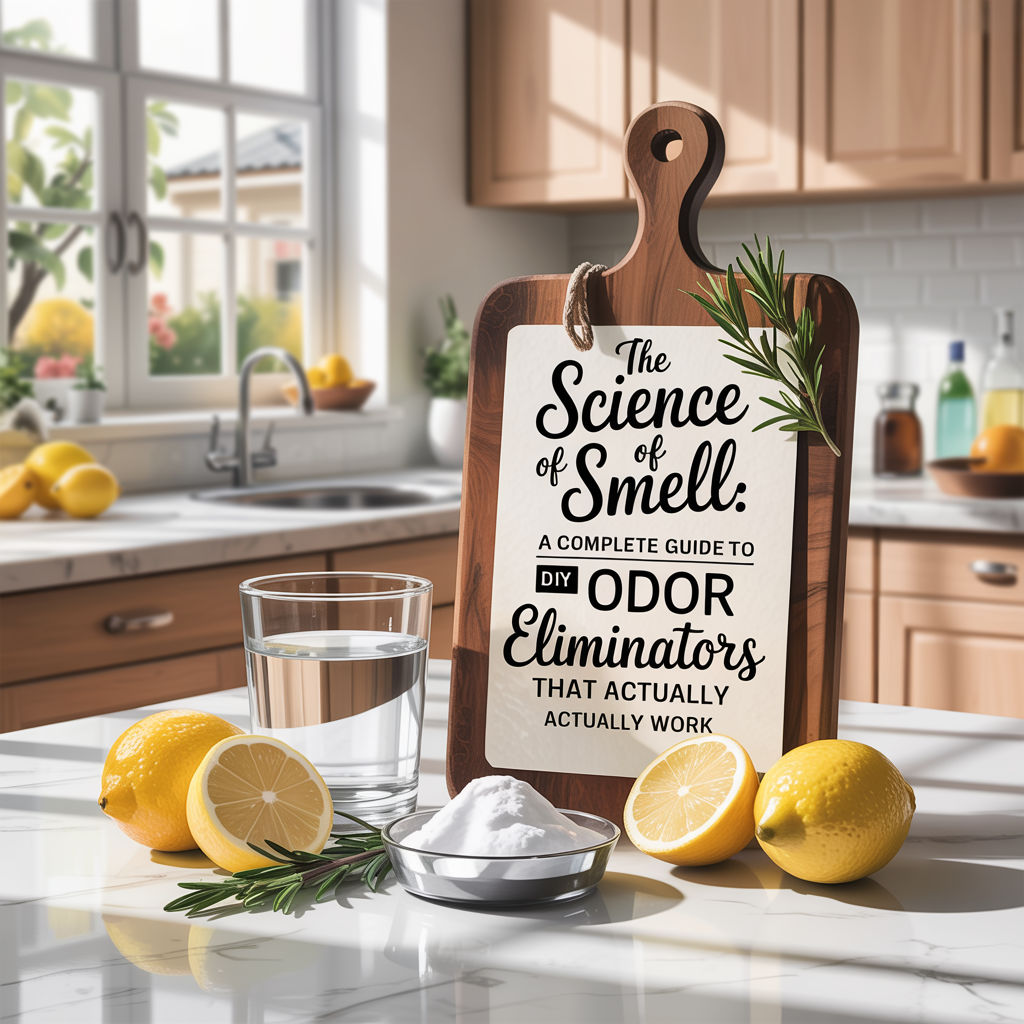
There is an invisible architecture that defines the comfort of our homes, and it’s the quality of the air we breathe. A persistent, unpleasant odor can disrupt our sense of peace and cleanliness more than any visible mess. For decades, the commercial response has been to sell us heavily odor eliminators perfumed sprays, plug-ins, and gels.
But I am here to tell you that this approach is fundamentally flawed. Masking an odor with a stronger, synthetic scent is like shouting over a problem instead of solving it. To truly reclaim the freshness of your space, you must become an odor eliminator, not an odor masker.
Welcome to your next great home experiment. This is my definitive guide to the science of smell and the creation of effective DIY odor eliminators. We are not just going to follow a few simple recipes; we are going to dive deep into the chemistry and physics of what an odor is and the three distinct scientific principles we can use to destroy it: Absorption, Neutralization, and Decomposition.
My goal is to empower you with knowledge so you can move beyond any single recipe and begin to formulate your own solutions. You’ll learn to diagnose the type of odor you’re dealing with and choose the precise scientific tool to eradicate it safely, naturally, and permanently. Let’s clear the air, once and for all.
The Illusion of “Fresh Linen”: Why Masking Odors Fails
Before we build, we must understand the flaw in the alternative. Most commercial air fresheners work by releasing a cloud of chemical perfumes and nerve-desensitizing agents. These chemicals don’t remove the offending odor molecules; they simply overwhelm your olfactory receptors so you can’t perceive the bad smell anymore. Many of these products contain Volatile Organic Compounds (VOCs), which can contribute to indoor air pollution and may pose health risks.
A true odor elimination strategy, like the ones we will develop here, works by physically removing, changing, or destroying the odor-causing molecules themselves. It is the difference between turning off a loud noise and simply putting on earmuffs. We are aiming for true silence.
The First Principle: Absorption (The Molecular Trap)
The most straightforward way to remove odor molecules from the air is to trap them. This is achieved using materials with an incredibly porous structure, creating a vast surface area where smelly molecules can get stuck.
The Science of Absorption: A Microscopic Sponge
Imagine a sponge soaking up water. An odor absorber works in a similar way, but on a microscopic level. Materials like activated charcoal and baking soda are filled with millions of tiny pores and crevices. When airborne odor molecules (which are just volatile chemical compounds) pass by, they are pulled into these pores and held there by a weak electrostatic attraction known as van der Waals forces. The molecule isn’t destroyed, but it is effectively taken out of circulation, and thus, out of your nose. The more surface area a material has, the more effective it is as an absorber.
Your Primary Absorber: Activated Charcoal (The Black Magic)
Activated charcoal is a form of carbon that has been processed to be exceptionally porous. A single gram of activated charcoal can have a surface area of over 3,000 square meters. It is the undisputed champion of absorption.
Experiment #1: The Reusable Activated Charcoal Purifying Bag
The Problem It Solves: Persistent, ambient odors in enclosed spaces like closets, musty bathrooms, shoe racks, or cars.
Materials:
Small, breathable fabric bags (cotton, linen, or burlap are perfect).
Activated charcoal granules (available online or in pet stores for aquarium filters).
Procedure:
Simply fill a fabric bag with 1/2 to 1 cup of activated charcoal granules.
Tie the bag securely to prevent spills.
Place the bag in the desired location.
How It Works: The bag allows air to circulate freely, bringing odor molecules into contact with the charcoal, where they are trapped.
C. Holmes’s Pro-Tip: This is not a one-time use product! Every month or two, place the charcoal bag outside in direct sunlight for a few hours. The heat and UV radiation from the sun will cause the charcoal to release the trapped molecules, effectively “recharging” it for another round of use.
Your Kitchen Staple Absorber: Baking Soda (Sodium Bicarbonate)
While not as powerful as charcoal, baking soda is an excellent and readily available absorber. It has the added benefit of being a weak alkali, meaning it can also neutralize acidic odors.
Experiment #2: The Customizable Fridge & Cabinet Deodorizer
The Problem It Solves: Food odors in refrigerators and stuffy smells in cabinets or under the sink.
Materials:
A small, wide-mouthed glass jar.
1 cup of baking soda.
(Optional) 5-10 drops of a pure essential oil like lemon or lavender.
A piece of breathable fabric and a rubber band, or a lid with holes punched in it.
Procedure:
Pour the baking soda into the jar. If using, add the essential oil drops and stir to combine.
Cover the jar with the fabric and secure it, or use the perforated lid.
Place in the back of your refrigerator or cabinet.
How It Works: The baking soda absorbs ambient odor molecules. The essential oil provides a gentle, pleasant scent, but it’s the baking soda doing the heavy lifting of elimination. Replace every 1-2 months.
The Second Principle: Neutralization (The Chemical Handshake)
Some odors are too aggressive to be simply trapped. These need to be chemically altered into a new, non-stinky molecule. This is neutralization.
The Science of Neutralization: Winning the pH Battle
As we learned in my Science of Stain Removal guide, many chemical compounds, including smelly ones, can be classified as either acidic or alkaline. Foul odors from spoiled food or sweat are often acidic. Pungent smells from fish or other sources can be alkaline (specifically, compounds called amines). By applying a substance with an opposite pH, you can trigger a chemical reaction that neutralizes the odor. An acid plus a base creates a neutral salt and water—neither of which has a strong smell.
Your Primary Neutralizer: White Vinegar (The Acidic Workhorse)
Distilled white vinegar is a dilute solution of acetic acid. Its low pH makes it a powerful weapon against alkaline odors. Don’t worry about the vinegar smell; the acetic acid is highly volatile and dissipates as it dries, taking the offending odor with it.
Experiment #3: The All-Purpose Odor-Neutralizing Spray
The Problem It Solves: Lingering cooking odors (like fish or burnt popcorn) in the air, on countertops, and on fabrics.
Materials:
A clean spray bottle.
1 part distilled white vinegar.
1 part filtered water.
(Optional) A few sprigs of rosemary or the peels of a lemon or orange.
Procedure:
Combine the vinegar and water in the spray bottle.
If using, add the rosemary or citrus peels to the bottle to infuse the liquid with a natural scent. Let it sit for a day before first use.
To use, spray it lightly into the air or directly onto hard surfaces (like countertops and cutting boards) and wipe clean. You can also lightly mist it onto fabrics like curtains or upholstery.
How It Works: The acetic acid molecules in the mist bind with and neutralize the alkaline odor molecules.
Crucial Safety Note: As a potent acid, vinegar should never be used on natural stone surfaces like marble or granite, as it can cause etching. Always test on an inconspicuous spot on fabrics first.
The Third Principle: Decomposition (The Enzymatic Assault)
The toughest odors—think pet accidents or spoiled milk on a carpet—are caused by complex organic matter. These require a more advanced solution that doesn’t just trap or neutralize, but completely breaks them down.
The Science of Decomposition: Using Enzymes to Devour Odors
Enzymes are specialized proteins that act as biological catalysts. They target specific types of molecules and trigger a reaction that rapidly breaks them down into smaller, simpler, and—most importantly—odorless components like carbon dioxide and water. An enzymatic cleaner is essentially a bottle of microscopic “Pac-Men” programmed to eat the specific organic matter causing the smell.
Your DIY Decomposer: The Fermented Citrus Enzyme Cleaner
This is a true “Home Lab” experiment. It requires patience, but the result is an incredibly powerful, all-natural cleaner and decomposer that costs next to nothing. This process uses fermentation, a technique we explored in my DIY Fermentation Fundamentals guide.
Experiment #4: The Long-Brew Citrus Enzyme Cleaner
The Problem It Solves: Potent organic odors from pet urine, vomit, garbage cans, and drains. It’s a powerful degreaser and multi-purpose cleaner.
Materials:
A large plastic bottle or jug with a screw-on cap (plastic is essential as it can flex with gas buildup).
3 parts citrus peels (lemon, orange, grapefruit, lime).
1 part brown sugar.
10 parts water.
Procedure:
Chop the citrus peels into smaller pieces and place them in the plastic bottle.
Add the brown sugar and then the water. Leave about 20% of the bottle empty for gas.
Screw the cap on tightly and shake the bottle well to dissolve the sugar.
For the first two weeks, you must unscrew the cap briefly every day to release the fermentation gases. This is critical to prevent the bottle from bursting.
Store the bottle in a cool, dark place for 3 months. This is the time it takes for the fermentation process to complete and the powerful enzymes to develop.
After 3 months, the liquid will be a dark brownish color with a sweet, vinegary scent. Strain out the solid peels.
How to Use: Dilute the finished enzyme cleaner with water at a 1:10 ratio in a spray bottle. Spray it directly onto the source of the organic odor and let it air dry. The enzymes will go to work, digesting the organic matter completely.
The Strategic Application: An Odor-Solver’s Matrix
To put it all together, here is a quick guide to choosing the right tool for the job.
The Problem: Musty closet or stuffy bathroom.
The Solution: Absorption (Activated Charcoal Bag).
The Reason: The odor is ambient and persistent, requiring a continuous, passive trap.
The Problem: Lingering smell of fried fish or onions in the kitchen.
The Solution: Neutralization (Vinegar & Water Spray).
The Reason: The odor is caused by alkaline molecules in the air and on surfaces that need to be chemically neutralized by an acid.
The Problem: A funky, unidentifiable smell coming from the refrigerator.
The Solution: Absorption & Neutralization (Baking Soda Deodorizer).
The Reason: It needs to absorb a wide variety of food odors while also neutralizing any acidic smells from spoiling produce.
The Problem: A pet has an accident on the rug.
The Solution: Decomposition (Citrus Enzyme Cleaner).
The Reason: The odor is from complex organic proteins (urea) that must be completely broken down, not just covered up or neutralized.
Frequently Asked Questions (FAQ)
Can I just use coffee grounds to absorb odors?
Coffee grounds can absorb some odors, but they primarily work by masking them with their own strong scent. For true, scent-free absorption, baking soda and activated charcoal are far superior as they do not impart a smell of their own.
How long do these DIY eliminators last?
The activated charcoal bag can be “recharged” in sunlight for years. The baking soda deodorizer should be replaced every 1-2 months as it becomes saturated. The vinegar spray’s effectiveness is immediate upon use. The citrus enzyme cleaner, once made, is stable and will last for over a year if stored in a cool, dark place.
Is it safe to use essential oils in these recipes if I have pets?
You must be extremely cautious. Many essential oils, especially tea tree, citrus oils, and peppermint, are toxic to cats and dogs. If you have pets, I strongly recommend forgoing the essential oils in these recipes or consulting your veterinarian about pet-safe options. The primary function of the eliminator (absorption/neutralization) works perfectly without them.
My DIY spray smells like vinegar. Will my house smell like a salad?
The vinegar smell is temporary. Acetic acid is highly volatile, meaning it evaporates quickly. As it evaporates, it takes the neutralized odor particles with it, leaving behind a neutral, fresh scent. The smell should be completely gone within 15-30 minutes of application.
Can I use the enzyme cleaner or vinegar spray on wood floors?
I would advise against it. Both vinegar and the citrus enzyme cleaner are acidic and can damage the finish on sealed hardwood floors over time. They are best suited for hard, non-porous surfaces like tile, linoleum, and countertops (excluding natural stone for vinegar).
The Invisible Architecture of a Fresh Home
You have just completed a masterclass in the science of odor elimination. You now understand that a fresh-smelling home is not the result of adding pleasant scents, but the product of scientifically removing unpleasant ones. By building your arsenal of absorbers, neutralizers, and decomposers, you have moved beyond the role of a simple cleaner and have become the chief scientist of your Home Lab. You can diagnose problems on a molecular level and formulate precise, natural, and effective solutions. This knowledge is the invisible architecture of a truly clean and peaceful home—one that doesn’t just smell like nothing, but feels like everything is exactly as it should be.

C. Holmes is the keen analytical mind behind Infinitas Minds, a blog dedicated to revolutionizing the way we approach home economics. With a meticulous eye for detail and a passion for logical solutions, C. Holmes tackles everyday challenges to reveal hidden opportunities for efficiency and savings. His mission is to simplify life, spark innovation, and offer practical, insightful approaches for navigating our often-complex world with greater ease and financial clarity.
Driven by a belief that true mastery of home economics lies in understanding the ‘why’ and ‘how’ behind every decision, C. Holmes curates comprehensive guides, actionable experiments, and groundbreaking perspectives. Expect a blend of sharp analysis, creative problem-solving, and a touch of ingenuity in every piece, empowering readers to transform their homes into havens of efficiency and peace.