
Does your home feel like a perpetual toy tsunami has just swept through? Are you constantly tripping over building blocks, searching for matching doll shoes, or wondering how so many tiny pieces appeared out of nowhere? You’re not alone.
For many families, toy clutter is a daily battle, impacting not just the tidiness of your home but also your peace of mind. But what if you could transform that overwhelming toy mess into a manageable, inspiring play space? Here at Infinitas Minds, I believe in smart, practical solutions for a more organized and joyful home life for everyone.
This comprehensive guide, brought to you by C. Holmes, is your definitive blueprint to master toy organization. We’ll delve into the common reasons why toys accumulate and provide actionable strategies to declutter, store, and maintain order in your children’s play areas.
Get ready to reclaim your living space, foster more focused and creative play, and finally enjoy the calm that comes with an organized home, even with kids in the mix.
You’ll have a clear system for toy management that benefits both children and adults. Are you ready to tame the toy chaos and rediscover the joy in your family’s home? Let’s get started!
Understanding the Toy Tsunami: Why Toy Organization is a Must for Families
Toys have a remarkable ability to multiply, seemingly overnight. From birthday gifts and holiday presents to impulse buys and hand-me-downs, the sheer volume can quickly overwhelm any home. This constant influx leads to several common challenges: children becoming overstimulated and unable to focus on play, parents feeling stressed and constantly cleaning up, and a general sense of chaos pervading living spaces.
Effective toy organization is crucial for more than just tidiness. When toys are manageable and accessible, children tend to engage in deeper, more creative play. It fosters independence as they can find and put away items themselves. For parents, it reduces the mental load and constant visual clutter.
Understanding that toy accumulation impacts both play quality and home peace is the first step toward implementing a strategic and lasting solution.
The C. Holmes Approach: Your Blueprint for Effective Toy Organization
Ready to bring order to your children’s play areas? The C. Holmes approach to toy organization focuses on creating sustainable systems, not just temporary fixes. My blueprint emphasizes simplicity, accessibility for kids, and consistent maintenance, ensuring your efforts lead to lasting calm and more meaningful play.
Here’s how this approach works:
- Less is More: We’ll start by reducing the sheer volume of toys, which is the most impactful step.
- Accessibility for Kids: The system should be easy for children to use, promoting their independence in choosing and putting away toys.
- Consistent Maintenance: Regular, small actions are key to preventing clutter from returning.
- Focus on Categories: Grouping similar toys together makes cleanup and playtime easier.
This systematic approach empowers you to take control of the toy chaos, transforming cluttered spaces into functional, inviting play zones.
Phase 1: The Great Toy Purge – Deciding What Stays, What Goes
This is the most critical phase of your toy organization journey. It’s time to gather every toy in your home and make honest decisions about what genuinely belongs. Don’t be daunted; we’ll break it down.
Your Practical Audit Steps:
- Gather All Toys: Collect every single toy from every room (living room, bedrooms, playroom, even the car). Bring them to one central sorting area. This visualization of the total volume can be very powerful.
- Sort into Categories: As you gather, create piles for similar items: building blocks, dolls, cars, art supplies, puzzles, board games, stuffed animals, etc.
- Evaluate Each Item (The “Stay or Go” Questions): Pick up each item individually and ask:
- Is it broken or missing pieces? If yes, discard or fix immediately.
- Has it been outgrown or rarely played with (in the last 6-12 months)? Consider donating.
- Is it a duplicate? Keep the best one, donate the rest.
- Does it spark joy or genuinely engage my child? (Adapt Marie Kondo’s principle here).
- Does it align with our family’s values (e.g., open-ended play, creativity)?
- Create Action Piles:
- Keep: Only the toys that truly meet your family’s criteria.
- Donate/Sell: Toys in good, usable condition that your children no longer use or have outgrown. Check local charities or consignment shops.
- Discard/Recycle: Broken, unsafe, or unusable toys.
- Maybe Box: For a few truly undecided items. Store this box out of sight for 3-6 months. If no one asks for these toys, you can confidently donate them.
- Involve Children (Age-Appropriately): For older children, involve them in the decision-making. Give them agency over their belongings, but guide them with the questions. For younger children, sort during naptime or after bedtime, keeping a few of their favorites to confirm later.
This thorough purge will dramatically reduce the volume of toys, making the subsequent steps of toy organization much more manageable.
Phase 2: Smart Toy Storage Solutions – Maximizing Space & Accessibility
Once you’ve purged the excess, it’s time to give every remaining toy a designated “home.” Phase 2 of your toy organization journey focuses on implementing smart storage solutions that maximize your space and, crucially, make toys easily accessible for your children.
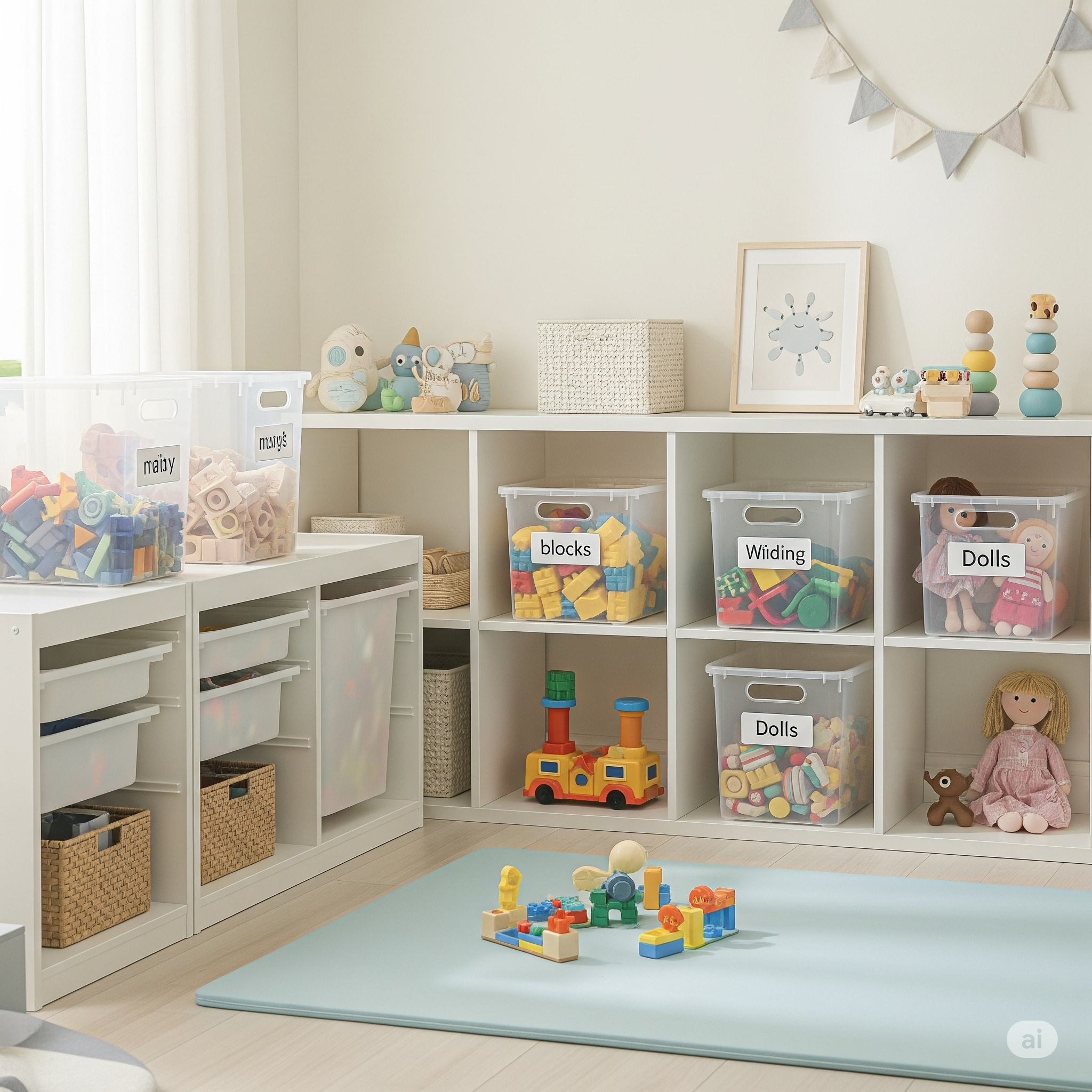
- Clear Bins & Containers: Transparent bins are a game-changer! They allow children to see what’s inside, reducing the need to dump everything out. Use them for smaller, categorized toys (e.g., one bin for LEGOs, one for toy cars).
- Open Shelving: Instead of closed cabinets, open shelves make toys visible and easy for children to retrieve and put away. Combine with bins for a neat look.
- Dedicated Toy Chests (with caution): While traditional toy chests can hold a lot, they can also become “black holes.” Use them for larger, bulky items or for toys that are part of a rotation system (see Phase 3).
- Vertical Storage: Utilize wall space with wall-mounted shelves, pegboards, or hanging organizers for stuffed animals or smaller items. This is especially useful in smaller homes.
- Furniture with Built-in Storage: Benches with lift-up lids, ottomans, or beds with drawers can be excellent multi-functional pieces for discreet toy storage.
- Categorize & Label: Store similar toys together (e.g., all art supplies in one caddy, all dress-up clothes in one bin). Use picture labels for younger children and word labels for older ones to encourage independent cleanup.
By organizing toys logically and accessibly, you’re not just creating a tidy space, but empowering your children’s independent play and streamlining your toy organization efforts.
Phase 3: Implementing a Toy Rotation System – Keeping Play Fresh & Clutter Low
One of the most powerful strategies in toy organization is implementing a toy rotation system. This brilliant method involves storing a portion of your children’s toys out of sight and periodically rotating them back into active play. It’s a win-win: less visual clutter for you, and a renewed sense of excitement and engagement for your children.
Benefits of Toy Rotation:
- Reduces Overwhelm: Fewer toys available at one time means less visual clutter and helps children focus on the toys they have.
- Boosts Creativity: Children play more deeply and creatively with a smaller selection of toys, fostering imaginative play.
- Renews Interest: When toys are “new” again after a rotation, children often rediscover them with enthusiasm.
- Simplifies Cleanup: Less mess means faster and easier tidying.
How to Implement a Simple Toy Rotation:
- Divide & Conquer: Group your children’s toys into 2-4 main “sets” or rotations. Keep one set accessible for play.
- Store Out of Sight: Store the other sets in clear bins (labeled!) in a closet, garage, or under a bed.
- Establish a Rotation Schedule: Rotate toys every few weeks or once a month, or whenever you notice interest waning. You can involve your child in choosing which toys to bring out next.
A toy rotation system is a proactive step in your toy organization journey, keeping play fresh and your home clutter-free.
Building Daily Habits: Maintaining Your Organized Play Space
The true test of effective toy organization is how well it’s maintained. Once you’ve purged and set up your systems, building consistent daily habits for both children and parents is paramount to keeping toy chaos at bay. These small, regular actions are far more effective than sporadic, overwhelming cleanups.
- The “5-Minute Tidy-Up” Before Bed: Make it a family ritual. Before bedtime, dedicate 5-10 minutes to a quick toy tidy-up. Play upbeat music and make it a fun “race.” This ensures you wake up to a calmer living space.
- “A Home for Every Toy”: Teach children that every toy has a designated “home.” When they’re done playing, the toy goes back to its spot. Use clear labels (pictures for preschoolers!) to make this easy.
- “One In, One Out” Rule for New Toys: For every new toy that enters your home (especially after birthdays or holidays), encourage your child to choose one old toy to donate. This prevents future accumulation.
- Morning Reset for Play Areas: As part of your general “15-Minute Daily Home Reset”, quickly reset play areas, putting away items left out from the previous day.
- Model the Behavior: Children learn by example. When they see you tidying up your own belongings, they are more likely to adopt similar habits.
By integrating these simple habits, you’re not just maintaining an organized play space; you’re teaching valuable life skills and contributing to a more peaceful and functional home for everyone.
FAQs: Your Toy Organization Questions Answered by C. Holmes
Here are answers to common questions I receive about toy organization:
- How do I get my kids to help with toy organization? Start small, make it fun, and be consistent. Use clear, visual labels. Turn cleanup into a game (e.g., “race the timer”). Praise their efforts. Involve them in age-appropriate decluttering decisions.
- What about gifts from grandparents or friends? Acknowledge and appreciate the gift, but then apply your “one in, one out” rule or integrate the new toy into your rotation system. You don’t have to keep every single gift if it doesn’t fit your family’s toy philosophy.
- How many toys are too many? There’s no magic number. “Too many” is when toys are constantly overflowing their designated storage, overwhelming your child, or causing daily stress for you. If a toy isn’t used, loved, or accessible, it might be too many for your space.
- What’s the best way to store large, bulky toys? For large toys (e.g., dollhouses, play kitchens), assign them a specific, dedicated spot. Consider vertical storage or multi-functional furniture (like a window seat with storage). Sometimes, the best solution is to only keep one or two very large items if space is limited.
- My child has a strong attachment to every toy – what do I do? Acknowledge their feelings. For highly sentimental items, suggest a “memory box” for special keepsakes. Use the “maybe box” strategy for items they’re unsure about. Focus on the idea of giving toys a “new home” where other children can love them, rather than “getting rid of” them.

C. Holmes is the keen analytical mind behind Infinitas Minds, a blog dedicated to revolutionizing the way we approach home economics. With a meticulous eye for detail and a passion for logical solutions, C. Holmes tackles everyday challenges to reveal hidden opportunities for efficiency and savings. His mission is to simplify life, spark innovation, and offer practical, insightful approaches for navigating our often-complex world with greater ease and financial clarity.
Driven by a belief that true mastery of home economics lies in understanding the ‘why’ and ‘how’ behind every decision, C. Holmes curates comprehensive guides, actionable experiments, and groundbreaking perspectives. Expect a blend of sharp analysis, creative problem-solving, and a touch of ingenuity in every piece, empowering readers to transform their homes into havens of efficiency and peace.